Home

77.023.007

Object Title
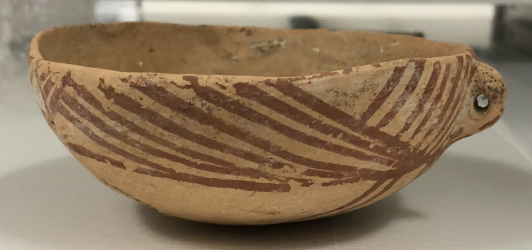
Bowl with handle (nob lug, white painted ware III)
Measurements
1 7/8 x 4 1/2 in (4.8 x 11.5 cm)
Creation Date
1850-1700 BCE (Middle Bronze Period)
Credit Line
Purchased using Membership Purchase Fund from Cypriot Government
Museum Contact
museum@cornell.edu
Culture
Country of Origin
Object Type
Materials / Techniques
Object URL
https://emuseum.cornell.edu/objects/45722/bowl-with-handle-nob-lug?ctx=6aa6f32df94e4a88e7ac6f5c9fea889b74594816&idx=0
Museum's Definition of Antiquity
Created before 542 CE. (Source: Sylvain Destephen. 542. La fin de l’antquité. Paris: PUF, 2025.)
Provenance Information
Property of Department of Antiquities, Cyprus -1977 [1]; transferred to the Johnson Museum of Art, 1977.

[1] Excavation provenance is unknown.
Exhibition Information
None known.
Publication Information
None known.
Section of the AAMD Guidelines relied upon for the exception to 1970
Cumulative facts and circumstances
Explain why the object fits the exception set forth above
The 1977 purchase from the Department of Antiquities in Cyprus is fully documented with letters to and from government officials, travel slips, shipping receipts, and the original accession documentation. 

77.23.006

Object Title
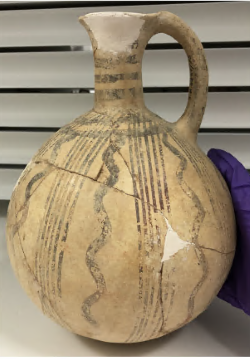
Jug with handle (white painted ware)
Measurements
9 ½ x 6 ½ in (24.2 x 16.6 cm)
Creation Date
ca. 1700 BCE (Middle Bronze Period)
Credit Line
Purchased using Membership Purchase Fund from Cypriot Government
Museum Contact
museum@cornell.edu
Culture
Country of Origin
Object Type
Materials / Techniques
Object URL
https://emuseum.cornell.edu/objects/45721/jug-with-handle?ctx=3d1bacf699c9227906d0fe2a25a3107a1954671c&idx=0
Museum's Definition of Antiquity
Created before 542 CE. (Source: Sylvain Destephen. 542. La fin de l’antquité. Paris: PUF, 2025.)
Provenance Information
The museum has chosen to post this work, acquired early in our collection’s creation, in hopes that other museums and scholars are able to learn from it. We are constantly working to improve our records of these early antiquities acquisitions, so please contact us if you have additional information. Property of Department of Antiquities, Cyprus -1977 [1]; transferred to the Johnson Museum of Art, 1977.


[1] Excavation provenance is unknown.
Exhibition Information
None known.
Publication Information
None known.
Section of the AAMD Guidelines relied upon for the exception to 1970
Cumulative facts and circumstances
Explain why the object fits the exception set forth above
The 1977 purchase from the Department of Antiquities in Cyprus is fully documented with letters to and from government officials, travel slips, shipping receipts, and the original accession documentation. 

77.023.005

Object Title
Fragmentary flask (jug, red polished ware)
Measurements
5 x 4 in (12.8 x 10.2 cm)
Creation Date
1800-1600 BCE (Middle Cypriot)
Credit Line
Purchased using Membership Purchase Fund from Cypriot Government
Museum Contact
museum@cornell.edu
Culture
Country of Origin
Object Type
Materials / Techniques
Object URL
https://emuseum.cornell.edu/objects/45720/fragmentary-flask-jug?ctx=4b5c3b3da3115d8b2692f4522aec473d40f56849&idx=0
Museum's Definition of Antiquity
Created before 542 CE. (Source: Sylvain Destephen. 542. La fin de l’antquité. Paris: PUF, 2025.)
Provenance Information
The museum has chosen to post this work, acquired early in our collection’s creation, in hopes that other museums and scholars are able to learn from it. We are constantly working to improve our records of these early antiquities acquisitions, so please contact us if you have additional information. Property of Department of Antiquities, Cyprus -1977 [1]; transferred to the Johnson Museum of Art, 1977.


[1] Excavation provenance is unknown.
Exhibition Information
None known
Publication Information
None known
Section of the AAMD Guidelines relied upon for the exception to 1970
Cumulative facts and circumstances
Explain why the object fits the exception set forth above
The 1977 purchase from the Department of Antiquities in Cyprus is fully documented with letters to and from government officials, travel slips, shipping receipts, and the original accession documentation. 

77.023.003

Object Title
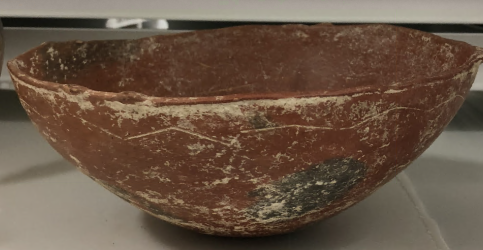
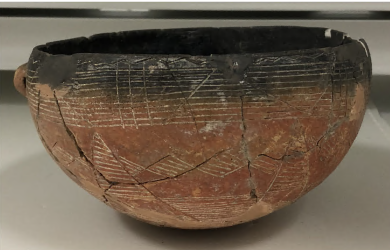
Nob lug bowl (with black top and incised geometric decoration, red polished ware II)
Measurements
4 x 6 ½ in (10.3 x 16.6 cm)
Creation Date
ca. 1800 BCE (Early II - Middle III)
Credit Line
Purchased using Membership Purchase Fund from Cypriot Government
Museum Contact
museum@cornell.edu
Culture
Country of Origin
Object Type
Materials / Techniques
Object URL
https://emuseum.cornell.edu/objects/45718/nob-lug-bowl?ctx=8e21e3a306aace6cd0bbb495a31e5bd7b7288152&idx=0
Museum's Definition of Antiquity
Created before 542 CE. (Source: Sylvain Destephen. 542. La fin de l’antquité. Paris: PUF, 2025.)
Provenance Information
The museum has chosen to post this work, acquired early in our collection’s creation, in hopes that other museums and scholars are able to learn from it. We are constantly working to improve our records of these early antiquities acquisitions, so please contact us if you have additional information. Property of Department of Antiquities, Cyprus -1977 [1]; transferred to the Johnson Museum of Art, 1977.

[1] Excavation provenance is unknown.
Exhibition Information
None known.
Publication Information
None known.
Section of the AAMD Guidelines relied upon for the exception to 1970
Cumulative facts and circumstances
Explain why the object fits the exception set forth above
The 1977 purchase from the Department of Antiquities in Cyprus is fully documented with letters to and from government officials, travel slips, shipping receipts, and the original accession documentation. 

77.023.002

Object Title
Bowl with small handles (red polished ware III)
Measurements
3 5/8 x 8 3/8 in (9.3 x 21.4 cm)
Creation Date
1850-1800 BCE (end of Early Bronze Period)
Credit Line
Purchased using Membership Purchase Fund from Cypriot Government
Museum Contact
museum@cornell.edu
Culture
Country of Origin
Object Type
Materials / Techniques
Object URL
https://emuseum.cornell.edu/objects/45717/bowl-with-small-handles?ctx=2bbf3f71a7b8bc464a101f3a84aaf6692dcd7ef8&idx=0
Museum's Definition of Antiquity
Created before 542 CE. (Source: Sylvain Destephen. 542. La fin de l’antquité. Paris: PUF, 2025.)
Provenance Information
The museum has chosen to post this work, acquired early in our collection’s creation, in hopes that other museums and scholars are able to learn from it. We are constantly working to improve our records of these early antiquities acquisitions, so please contact us if you have additional information. Property of Department of Antiquities, Cyprus -1977 [1]; transferred to the Johnson Museum of Art, 1977.


[1] Excavation provenance is unknown.
Exhibition Information
None known.
Publication Information
None known.
Section of the AAMD Guidelines relied upon for the exception to 1970
Cumulative facts and circumstances
Explain why the object fits the exception set forth above
The 1977 purchase from the Department of Antiquities in Cyprus is fully documented with letters to and from government officials, travel slips, shipping receipts, and the original accession documentation.
77.023.001

Object Title
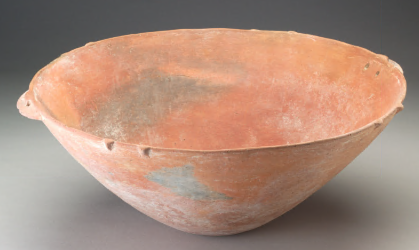
Bowl with two handles (red polished ware III)
Measurements
7 1/2 x 18 1/2 in (19.2 x 47.0 cm)
Creation Date
1850-1800 BCE (Early-Middle Cypriot)
Credit Line
Purchased using Membership Purchase Fund from Cyprus Dept. of Antiquities
Museum Contact
museum@cornell.edu
Culture
Country of Origin
Object Type
Materials / Techniques
Object URL
https://emuseum.cornell.edu/objects/41763/bowl-with-two-handles?ctx=2e8c1a557eabb0c74c071c4221b6436eeeb736cb&idx=0
Museum's Definition of Antiquity
Created before 542 CE. (Source: Sylvain Destephen. 542. La fin de l’antquité. Paris: PUF, 2025.)
Provenance Information
The museum has chosen to post this work, acquired early in our collection’s creation, in hopes that other museums and scholars are able to learn from it. We are constantly working to improve our records of these early antiquities acquisitions, so please contact us if you have additional information. Property of Department of Antiquities, Cyprus -1977 [1]; transferred to the Johnson Museum of Art, 1977.


[1] Excavation provenance is unknown.
Exhibition Information
None known.
Publication Information
None known.
Section of the AAMD Guidelines relied upon for the exception to 1970
Cumulative facts and circumstances
Explain why the object fits the exception set forth above
The 1977 purchase from the Department of Antiquities in Cyprus is fully documented with letters to and from government officials, travel slips, shipping receipts, and the original accession documentation.
2008.099

Object Title
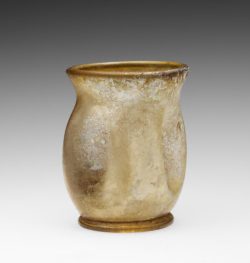
Roman glass beaker
Measurements
3 2/5 x 2 ¾ inches (9 x 7 cm)
Creation Date
ca. 1st-4th centuries CE
Credit Line
Gift of the Wunsch Foundation, Inc.
Museum Contact
museum@cornell.edu
Culture
Object Type
Materials / Techniques
Object URL
https://emuseum.cornell.edu/objects/41913/beaker?ctx=a820545c1072801185e3b1d81f2df6a83f04f48a&idx=2
Museum's Definition of Antiquity
Created before 542 CE. (Source: Sylvain Destephen. 542. La fin de l’antiquité. Paris: PUF, 2025.)
Provenance Information
Property of Wunsch Foundation, Inc. -2008 [1]; transferred to the Johnson Museum of Art, 2008.


[1] Donated by Martin Wunsch, (1925-2013)
Exhibition Information
None known.
Publication Information
None known.
Section of the AAMD Guidelines relied upon for the exception to 1970
Partial interest received prior to 2008
Explain why the object fits the exception set forth above
According to museum files, the museum first received information from the Wunsch Foundation, Inc. about the donation of objects, including the glass, in late 2007.

74.074.009

Object Title
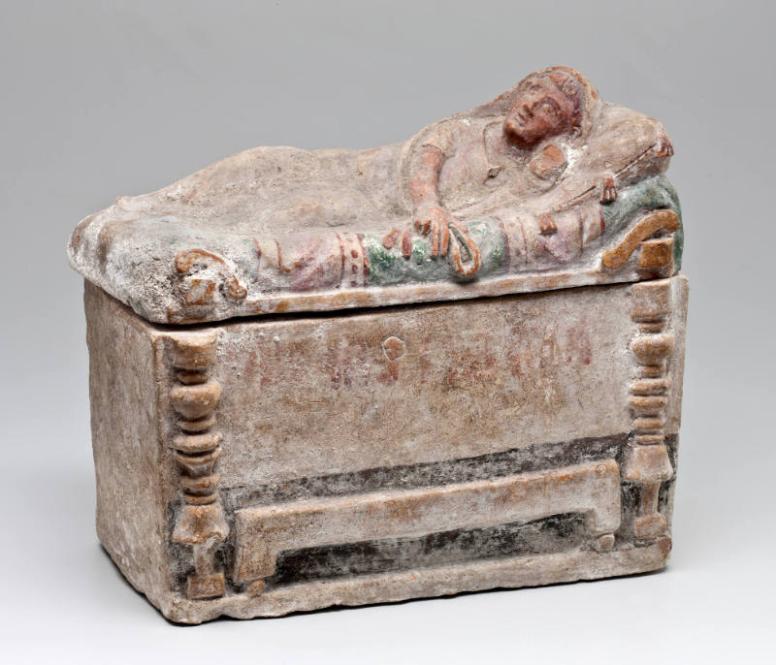
Etruscan cinerary urn
Measurements
11x12 3/4 x 6 3/8 in (27.9 x 32.4 x 16.2 cm)
Creation Date
100-35BCE
Credit Line
Transferred from University Collections
Museum Contact
museum@cornell.edu
Culture
Country of Origin
Object Type
Materials / Techniques
Object URL
https://emuseum.cornell.edu/objects/10509/cinerary-urn-in-the-shape-of-a-sarcophagus-with-reclining-ma?ctx=e2fdf438b9fdf68ae73a937b1859d9078adbf1d5&idx=0
Museum's Definition of Antiquity
Created before 542 CE. (Source: Sylvain Destephen. 542. La fin de l’antquité. Paris: PUF, 2025.)
Provenance Information
The museum has chosen to post this work, acquired early in our collection’s creation, in hopes that other museums and scholars are able to learn from it. We are constantly working to improve our records of these early antiquities acquisitions, so please contact us if you have additional information. Excavated April, 1861 near Chiusi, Italy [1]; 1863, donated to the German Archaeological Institute in Rome by signore Lovatti [2]; 1891–94, possibly acquired by Alfred Emerson, Associate Professor of Classical Archaeology at Cornell from 1891 to 1898 [3]; transferred (?) to Cornell University Collections [4]; transferred to the Johnson Museum of Art, 1974.


[1] Mazzetti, A[ntonio], and G. Henzen. 1861. "Scavi chiusini, da lettera di Monsig. A. Mazzetti a G. Henzen" In Bullettino dell'Instituto di Corrispondenza Archeologica, 209-210. Roma: Tipografia Tiberina.


[2] Brunn, Heinrich. 1863. “Adunanze dell’Instituto.” In Bullettino dell'Instituto di Corrispondenza Archeologica, 10. Roma: Tipografia Tiberina, 10.


[3] Alfred Emerson (1859-1943) is responsible for the acquisition and distribution of large quantities Etruscan material to Cornell and other university museums (see the Phoebe A. Hearst Museum in Berkeley, CA). There are no photos or detailed enough records of his acquisitions during his travels to discern whether this urn was among those transported to Cornell by Emerson, but the lacuna in the provenance chronology aligns with Emerson’s lifespan and trips to Europe. It is extremely likely Emerson acquired the urn in the late 19th century.


[4] McGraw Hall until 1906, then likely in Goldwin-Smith Hall Classics Collection until its transfer to the Johnson Museum of Art in 1974.

Exhibition Information
On view, Herbert F. Johnson Museum of Art, Ithaca, NY, 2023-present.

“Wonder and Wakefulness: The Nature of Pliny the Elder,” curated by Andrew C. Weislogel and Verity J. Platt. Herbert F. Johnson Museum of Art, Ithaca, NY, January 21–June 11, 2023.


“Vessels: Stylistic and Functional Reflections of the Ancient World” Binghamton University Art Gallery, Binghamton, NY, Oct. 20–Nov. 19, 1978

HFJ reinstallation of permanent collection, Fall 1992

Publication Information
Wonder and Wakefulness: The Nature of Pliny the Elder, curated by Andrew C. Weislogel and Verity J. Platt. Herbert F. Johnson Museum of Art, Ithaca, NY, January 21–June 11, 2023. Exhibition book (Cornell University Press).

Estarán Tolosa, María José. 2016. Epigrafía bilingüe del Occidente romano. El latín y las lenguas locales en las inscripciones bilingües y mixtas. Zaragoza: Prensas de la Universidad de Zaragoza. pg 156-157, no. E18.

Huntsman, Theresa. 2015. "Inscribed Identities: Figural Cinerary Urns and Bilingualism in Late Etruscan Funerary Contexts at Chiusi." Etruscan Studies (Walter de Gruyter, Inc.) 18 (2): 81-96. Urn: pg 90-91.

Huntsman, Theresa. 2014. Eternal Personae: Chiusine Cinerary Urns and the Construction of Etruscan Identity, PhD diss., Washington University in St. Louis, ProQuest LLC (3613739). Urn: pg 105, no. 615.

Kuniholm, Peter I., Nancy H. Ramage, and Andrew Ramage. 2003. A Guide to the Classical Collections of Cornell University. Edited by Jane S. Terrell. Milan: Sfera International. pg 50-51, no. 18.

Benelli, Enrico. 1998. Le iscrizioni funerarie chiusine de età ellenistica. Vol. 64, in Studi etruschi, by Instituto Nazionale di Studi Etruschi ed Italici, 225-263 (pg 259, no. 19). Firenze: Editore Giorgio Bretschneider.

Benelli, Enrico. 1994. Le Iscrizioni Bilingui Etrusco-Latine. Edited by Leo S. Olschki. Firenze. Urn: pg 26-27, no. 20.

Gamurrini, Gian Francesco. 1874. "Adunanze dell'Instituto." In Bullettino dell'Instituto di Corrispondenza Archeologica, 81-82. Roma: Tipografia Tiberina. pg 81.

Brunn, Heinrich. 1863. “Adunanze dell’Instituto.” In Bullettino dell'Instituto di Corrispondenza Archeologica, 10 (no. 3). Roma: Tipografia Tiberina. Urn: pg 10.

Mazzetti, A[ntonio], and G. Henzen. 1861. "Scavi chiusini, da lettera di Monsig. A. Mazzetti a G. Henzen" In Bullettino dell'Instituto di Corrispondenza Archeologica, 209-210. Roma: Tipografia Tiberina. Urn: pg 209, no. 3.


Corpora:

Corpus Inscriptionum Latinarum (CIL) Vol. XI.1, id. 2202, in Deutsche Akademie der Wissenschaften zu Berlin. 1862. Corpus inscriptionum latinarum. 2202, vol. 11. Berlin: G. Reimer.

Corpus Inscriptionum Etruscarum (CIE) id. 1290, in Pauli, Carl Eugen, and Olof August Daniellson. 1893. Corpus Inscriptionum Etruscarum. 2190, vol. 1. 3 vols. Leipzig: J. A. Barth.

Etruskische Text (ET) id. Cl 1.220

Thesaurus Linguae Etruscae (TLE) id. 471
Section of the AAMD Guidelines relied upon for the exception to 1970
Informed judgement that works were outside of the country of modern discovery before 1970
Explain why the object fits the exception set forth above
Since Alfred Emerson likely acquired it in the late 19th century, and based on the entrance of other Etruscan materials securely attached to Emerson into Cornell’s collections in the late 19th to early 20th centuries, is overwhelmingly likely that this urn was a part of Cornell’s collection well before 1970.

2003.016

Object Title
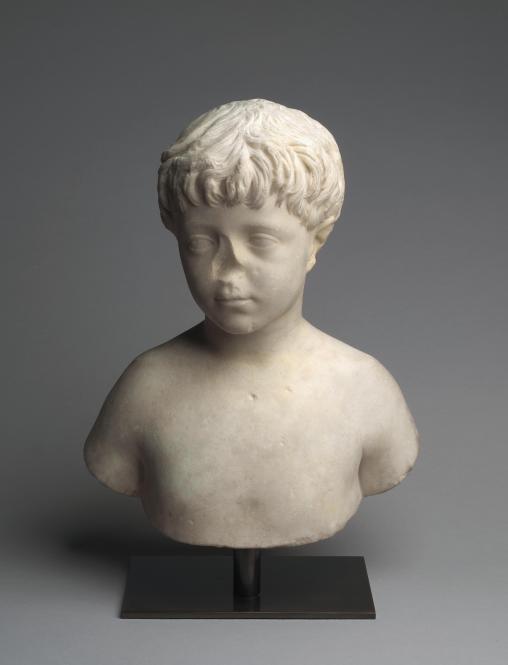
Bust of a boy
Measurements
Height: 14 15/16 inches (37.9 cm)
Creation Date
ca. 140 A.D.
Credit Line
Acquired through the generosity of Susan E. Lynch in honor of Elizabeth Trapnell Rawlings and Hunter R. Rawlings III, with additional support from the Ernest I. White, Class of 1893, Endowment Fund, and the Herbert F. Johnson, Class of 1922, Endowment
Museum Contact
museum@cornell.edu
Culture
Object Type
Materials / Techniques
Object URL
https://emuseum.cornell.edu/objects/38299/bust-of-a-boy?ctx=f86043b837be629d64079437bcfb7734df0b9cf3&idx=0
Museum's Definition of Antiquity
Created before 542 CE | Since the Roman empire persisted in Constantinople after 476, plague and political changes in 541–542 CE are cited as a more accurate transition from antiquity. (Sylvain Destephen. 542. La fin de l’antiquité. Paris, 2025.)
Provenance Information
Collection of Jules, Cardinal Mazarin (1602-1661) [1]. said to be in England in the late 18th century [2]. by 1872 collection of the Earl of Lonsdale, Lowther Castle, Penrith, Cumbria, England [3]; 1872-1944 collection of the Earls of Lonsdale (by descent) [4]; 1944-1947 estate of Hugh Cecil Lowther, 5th Earl of Lonsdale; [5] (1947 sold at Lowther Castle auction by estate of Hugh Cecil Lowther) [6]. -2003 collection of Charles Ede Limited, London [7]; 2003 collection of Herbert F. Johnson Museum of Art, Cornell University (sold through Charles Ede Limited, at The European Fine Art Fair (TEFAF), Maastricht) [8]

N.B. The provenance information listed here is taken directly from the object file, and is in the process of being confirmed.

[1] inventory number “132” carved in the back of the sculpture, which corresponds to two different inventories of Mazarin’s collection dated 1653 and 1661 respectively, with matching descriptions. See Michaelis, Adolf, and C. A. M. Fennell. Ancient Marbles in Great Britain. (Cambridge: At the University Press, 1882), 43-45, 667. [http://ebooks.library.ualberta.ca/local/ancientmarblesin00michuoft]

[2] According to Souren Melikian, “Safe Harbor” in Art & Auction (June 2003); p. 56: “The sculpture had arrived in England in the late 18th century and had been bought by the Earl of Lonsdale. It made a brief market appearance in April 1947 as part of the sale conducted as Lowther Castle in Penrith, Cumbria.”

[3] The date of acquisition by the Earls of Lonsdale is unclear because of apparent confusion between two William Lowthers, the 1st and 2nd Earls of Lonsdale, respectively, and the latter of whom died in 1872. As it was purchased by one of them, the death date of the second is used, until further information is obtained.

Prior to acquisition of the object, research was done by Herbert F. Johnson Museum of Art staff to determine which Earl purchased the bust, as Melikian notes only “the Earl of Lonsdale”, and an object factsheet from Charles Ede Limited, undated, states: “Ex. Collection The Earl of Lonsdale, Lowther Castle, sold as lot 549 in the sale of 15th April 1947.”

An internal memo summarizing the research, titled “The Earls of Lonsdale”, undated, it is noted that “the ‘Bust of Young Boy,’ 140 AD was probably acquired by an earlier earl [sic] (perhaps William Lowther, 2nd Earl of Lonsdale).” The dates given for him are 1757-1844, and the 3rd Earl of Lonsdale is identified as William Lowther (1787-1872).

However, according to the Oxford Dictionary of National Biography, William Lowther (1757-1844) was the 1st Earl of Lonsdale, and William Lowther (1787-1872) was the 2nd Earl of Lonsdale. [http://www.oxforddnb.com/view/article/17113?docPos=27], accessed 12-Dec-2013.

[4]-[7] Object factsheet from Charles Ede Limited, undated. Although this factsheet indicates the bust was sold on “15th April 1947” at the auction at Lowther Castle, according to a search of the auction catalogues through the Metropolitan Museum of Art’s Watsonline, the estate sale was held between April 29, 1947-May 1, 1947. Review of the catalogue(s) to confirm the correct date will be done. [http://http://library.metmuseum.org/], search terms “Lowther Castle”), run 12-Dec-2013.

[8] Invoice from Charles Ede Limited to Herbert F. Johnson Museum of Art, 13-May-2003.
Exhibition Information
None
Publication Information
Weideger, Paula, Will Bennett, Diana Cawdell, Gareth Harris, Celebrating the Best: Twenty Five Years of TEFAF Maastricht, ed. Will Bennett (Netherlands: TEFAF, 2012), p. 148.

European Fine Art Fair, TEFAF Maastricht, 2003: 14-23 March 2003, MECC Maastricht, the Netherlands (Netherlands: The Foundation, 2003); ref. p. 349, color illus. p. 349.

Souren Melikian, Safe Harbor, in Art & Auction (June 2003); disc. p. 52, 56, color illus. p. 52.

Linda Fuchs, The Antonine Boy Bust in the Herbert F. Johnson Museum of Art, Ithaca, New York (Ithaca: unpublished manuscript).

Herbert F. Johnson Museum of Art, Annual Report 2002-2003 (Ithaca: Cornell University, 2003); disc. p. 7-8, ref. p. 2, color illus. cover page.
Section of the AAMD Guidelines relied upon for the exception to 1970
Informed judgement that works were outside of the country of modern discovery before 1970
Explain why the object fits the exception set forth above
The bust was reportedly in the collection of Jules, Cardinal Mazarin until his death in 1661. It was then reported to be in England by the late 18th century where it remained until the Johnson Museum’s purchase in 2003.

2014.024.022

Object Title
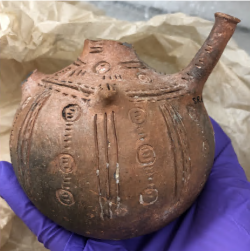
Spouted globular jug with handle
Measurements
H. 7 7/8 × dia. 6 11/16 in. (20 × 17 cm)
Creation Date
1000-600 BC
Credit Line
Gift of the Arthur M. Sackler Foundation
Culture
Country of Origin
Object URL
http://emuseum.cornell.edu/view/objects/asitem/items$0040:47473
Provenance Information
by 1970 collection of Farhadi & Anavian, New York; 1970-1987 collection of Arthur M. Sackler Collections, New York (purchased by Arthur M. Sackler from Farhadi & Anavian); 1987-1997 estate of Arthur M. Sackler; 1997 collection of Else Sackler (d. 2000), New York, NY (purchased from estate of Arthur M. Sackler); 1997-2014 collection of the Arthur M. Sackler Foundation, New York, NY (gift of Else Sackler); 2014 collection of Herbert F. Johnson Museum of Art, Cornell University, Ithaca, NY (gift of The Arthur M. Sackler Foundation)
Exhibition Information
The Lowe Art Museum, University of Miami, Miami, Florida, Ancient Iranian Ceramics from The Arthur M. Sackler Collections, October 9, 1987 - January 31, 1988

Museum of New Mexico, Museum of Fine Arts ,Santa Fe, New Mexico, Wit And Wine: A New Look at Ancient Iranian Ceramics from the Arthur M. Sackler Foundation, February 19–September 6, 1999; The Yager Museum, Hartwick College, Oneonta, New York, September 24, 1999–June 2, 2000; Krannert Art Museum, University of Illinois at Urbana-Champaign, Champaign, Illinois, July 14–December 17, 2000; Palmer Museum of Art, The Pennsylvania State University, University Park, Pennsylvania, June 12–August 12, 2001; Brooklyn Museum of Art, Brooklyn, New York, September 7–December 30, 2001; Frank H. McClung Museum, The University of Tennessee, Knoxville, Tennessee, February 22–May 19, 2002; Museum of Art and Archaeology, University of Missouri-Columbia, Columbia, Missouri, August 10–December 22, 2002; Holter Museum of Art, Helena, Montana, January 24–April 27, 2003; COPIA: The American Center for Wine, Food & the Arts, Napa, California, May 22–September 1, 2003; University of Wyoming Art Museum, Laramie, Wyoming, October 18–December 23, 2003; Dennos Museum Center, Northwestern Michigan College, Traverse City, Michigan, March 20–September 5, 2004; Ceramics Research Center, Arizona State University Art Museum, Tempe, Arizona, October 16, 2004–January 8, 2005; The Berkshire Museum, Pittsfield, Massachusetts, May 14–October 30, 2005
Publication Information
Trudy S. Kawami. Ancient Iranian Ceramics from the Arthur M. Sackler Collections. (New York, N.Y.: The Arthur M. Sackler Foundation, 1992); cat. no. 45, p. 126-127.

Wit and Wine: A New Look at Ancient Iranian Ceramics from the Arthur M. Sackler Foundation. University of Missouri-Columbia Museum of Art and Archeology, 2002. http://arthurmsacklerfdn.org/pdf/wit-wine/WitWine-UniversityofMissouri-2002.pdf (pg. 18).
Section of the AAMD Guidelines relied upon for the exception to 1970
Cumulative facts and circumstances
Explain why the object fits the exception set forth above
Part of a larger gift from the Arthur M. Sackler Foundation that, according to correspondence and documentation on file, was acquired by Dr. Sackler from Farhadi & Anavian, New York, in 1970.
Subscribe to Herbert F. Johnson Museum of Art, Cornell University