
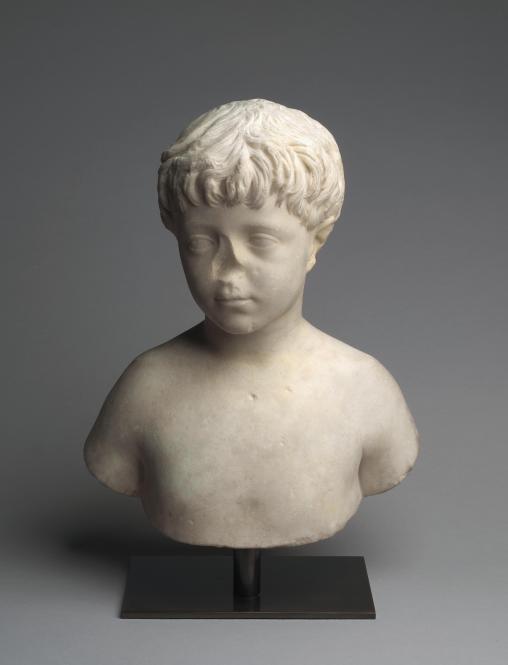
Object Title
Bust of a boy
Measurements
Height: 14 15/16 inches (37.9 cm)
Creation Date
ca. 140 A.D.
Credit Line
Acquired through the generosity of Susan E. Lynch in honor of Elizabeth Trapnell Rawlings and Hunter R. Rawlings III, with additional support from the Ernest I. White, Class of 1893, Endowment Fund, and the Herbert F. Johnson, Class of 1922, Endowment
Museum Contact
museum@cornell.edu
Culture
Country of Origin
Object Type
Materials / Techniques
Object URL
https://emuseum.cornell.edu/objects/38299/bust-of-a-boy?ctx=f86043b837be629d64079437bcfb7734df0b9cf3&idx=0
Museum's Definition of Antiquity
Created before 542 CE | Since the Roman empire persisted in Constantinople after 476, plague and political changes in 541–542 CE are cited as a more accurate transition from antiquity. (Sylvain Destephen. 542. La fin de l’antiquité. Paris, 2025.)
Provenance Information
Collection of Jules, Cardinal Mazarin (1602-1661) [1]. said to be in England in the late 18th century [2]. by 1872 collection of the Earl of Lonsdale, Lowther Castle, Penrith, Cumbria, England [3]; 1872-1944 collection of the Earls of Lonsdale (by descent) [4]; 1944-1947 estate of Hugh Cecil Lowther, 5th Earl of Lonsdale; [5] (1947 sold at Lowther Castle auction by estate of Hugh Cecil Lowther) [6]. -2003 collection of Charles Ede Limited, London [7]; 2003 collection of Herbert F. Johnson Museum of Art, Cornell University (sold through Charles Ede Limited, at The European Fine Art Fair (TEFAF), Maastricht) [8]
N.B. The provenance information listed here is taken directly from the object file, and is in the process of being confirmed.
[1] inventory number “132” carved in the back of the sculpture, which corresponds to two different inventories of Mazarin’s collection dated 1653 and 1661 respectively, with matching descriptions. See Michaelis, Adolf, and C. A. M. Fennell. Ancient Marbles in Great Britain. (Cambridge: At the University Press, 1882), 43-45, 667. [http://ebooks.library.ualberta.ca/local/ancientmarblesin00michuoft]
[2] According to Souren Melikian, “Safe Harbor” in Art & Auction (June 2003); p. 56: “The sculpture had arrived in England in the late 18th century and had been bought by the Earl of Lonsdale. It made a brief market appearance in April 1947 as part of the sale conducted as Lowther Castle in Penrith, Cumbria.”
[3] The date of acquisition by the Earls of Lonsdale is unclear because of apparent confusion between two William Lowthers, the 1st and 2nd Earls of Lonsdale, respectively, and the latter of whom died in 1872. As it was purchased by one of them, the death date of the second is used, until further information is obtained.
Prior to acquisition of the object, research was done by Herbert F. Johnson Museum of Art staff to determine which Earl purchased the bust, as Melikian notes only “the Earl of Lonsdale”, and an object factsheet from Charles Ede Limited, undated, states: “Ex. Collection The Earl of Lonsdale, Lowther Castle, sold as lot 549 in the sale of 15th April 1947.”
An internal memo summarizing the research, titled “The Earls of Lonsdale”, undated, it is noted that “the ‘Bust of Young Boy,’ 140 AD was probably acquired by an earlier earl [sic] (perhaps William Lowther, 2nd Earl of Lonsdale).” The dates given for him are 1757-1844, and the 3rd Earl of Lonsdale is identified as William Lowther (1787-1872).
However, according to the Oxford Dictionary of National Biography, William Lowther (1757-1844) was the 1st Earl of Lonsdale, and William Lowther (1787-1872) was the 2nd Earl of Lonsdale. [http://www.oxforddnb.com/view/article/17113?docPos=27], accessed 12-Dec-2013.
[4]-[7] Object factsheet from Charles Ede Limited, undated. Although this factsheet indicates the bust was sold on “15th April 1947” at the auction at Lowther Castle, according to a search of the auction catalogues through the Metropolitan Museum of Art’s Watsonline, the estate sale was held between April 29, 1947-May 1, 1947. Review of the catalogue(s) to confirm the correct date will be done. [http://http://library.metmuseum.org/], search terms “Lowther Castle”), run 12-Dec-2013.
[8] Invoice from Charles Ede Limited to Herbert F. Johnson Museum of Art, 13-May-2003.
Exhibition Information
None
Publication Information
Weideger, Paula, Will Bennett, Diana Cawdell, Gareth Harris, Celebrating the Best: Twenty Five Years of TEFAF Maastricht, ed. Will Bennett (Netherlands: TEFAF, 2012), p. 148.
European Fine Art Fair, TEFAF Maastricht, 2003: 14-23 March 2003, MECC Maastricht, the Netherlands (Netherlands: The Foundation, 2003); ref. p. 349, color illus. p. 349.
Souren Melikian, Safe Harbor, in Art & Auction (June 2003); disc. p. 52, 56, color illus. p. 52.
Linda Fuchs, The Antonine Boy Bust in the Herbert F. Johnson Museum of Art, Ithaca, New York (Ithaca: unpublished manuscript).
Herbert F. Johnson Museum of Art, Annual Report 2002-2003 (Ithaca: Cornell University, 2003); disc. p. 7-8, ref. p. 2, color illus. cover page.
Section of the AAMD Guidelines relied upon for the exception to 1970
Informed judgement that works were outside of the country of modern discovery before 1970
Explain why the object fits the exception set forth above
The bust was reportedly in the collection of Jules, Cardinal Mazarin until his death in 1661. It was then reported to be in England by the late 18th century where it remained until the Johnson Museum’s purchase in 2003.