
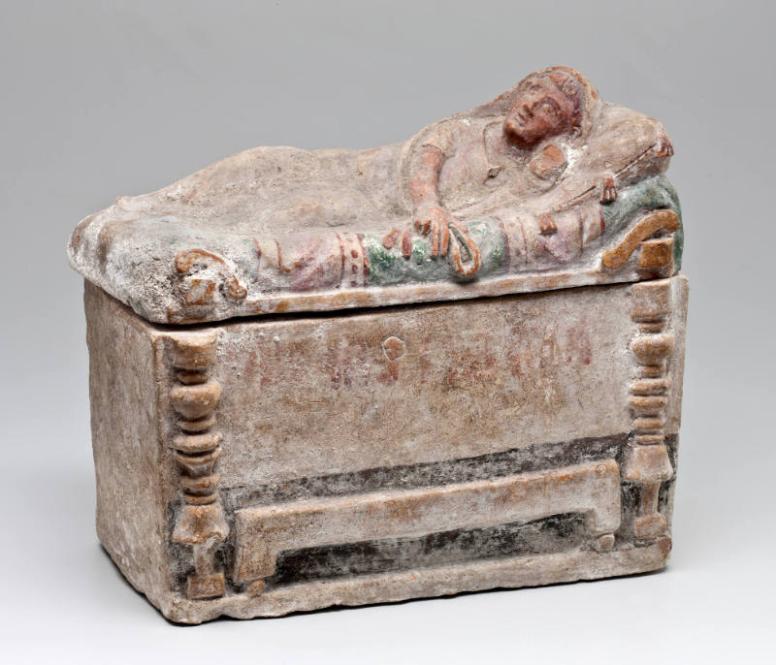
Object Title
Etruscan cinerary urn
Measurements
11x12 3/4 x 6 3/8 in (27.9 x 32.4 x 16.2 cm)
Creation Date
100-35BCE
Credit Line
Transferred from University Collections
Museum Contact
museum@cornell.edu
Culture
Country of Origin
Object Type
Materials / Techniques
Object URL
https://emuseum.cornell.edu/objects/10509/cinerary-urn-in-the-shape-of-a-sarcophagus-with-reclining-ma?ctx=e2fdf438b9fdf68ae73a937b1859d9078adbf1d5&idx=0
Museum's Definition of Antiquity
Created before 542 CE. (Source: Sylvain Destephen. 542. La fin de l’antquité. Paris: PUF, 2025.)
Provenance Information
The museum has chosen to post this work, acquired early in our collection’s creation, in hopes that other museums and scholars are able to learn from it. We are constantly working to improve our records of these early antiquities acquisitions, so please contact us if you have additional information. Excavated April, 1861 near Chiusi, Italy [1]; 1863, donated to the German Archaeological Institute in Rome by signore Lovatti [2]; 1891–94, possibly acquired by Alfred Emerson, Associate Professor of Classical Archaeology at Cornell from 1891 to 1898 [3]; transferred (?) to Cornell University Collections [4]; transferred to the Johnson Museum of Art, 1974.
[1] Mazzetti, A[ntonio], and G. Henzen. 1861. "Scavi chiusini, da lettera di Monsig. A. Mazzetti a G. Henzen" In Bullettino dell'Instituto di Corrispondenza Archeologica, 209-210. Roma: Tipografia Tiberina.
[2] Brunn, Heinrich. 1863. “Adunanze dell’Instituto.” In Bullettino dell'Instituto di Corrispondenza Archeologica, 10. Roma: Tipografia Tiberina, 10.
[3] Alfred Emerson (1859-1943) is responsible for the acquisition and distribution of large quantities Etruscan material to Cornell and other university museums (see the Phoebe A. Hearst Museum in Berkeley, CA). There are no photos or detailed enough records of his acquisitions during his travels to discern whether this urn was among those transported to Cornell by Emerson, but the lacuna in the provenance chronology aligns with Emerson’s lifespan and trips to Europe. It is extremely likely Emerson acquired the urn in the late 19th century.
[4] McGraw Hall until 1906, then likely in Goldwin-Smith Hall Classics Collection until its transfer to the Johnson Museum of Art in 1974.
Exhibition Information
On view, Herbert F. Johnson Museum of Art, Ithaca, NY, 2023-present.
“Wonder and Wakefulness: The Nature of Pliny the Elder,” curated by Andrew C. Weislogel and Verity J. Platt. Herbert F. Johnson Museum of Art, Ithaca, NY, January 21–June 11, 2023.
“Vessels: Stylistic and Functional Reflections of the Ancient World” Binghamton University Art Gallery, Binghamton, NY, Oct. 20–Nov. 19, 1978
HFJ reinstallation of permanent collection, Fall 1992
Publication Information
Wonder and Wakefulness: The Nature of Pliny the Elder, curated by Andrew C. Weislogel and Verity J. Platt. Herbert F. Johnson Museum of Art, Ithaca, NY, January 21–June 11, 2023. Exhibition book (Cornell University Press).
Estarán Tolosa, María José. 2016. Epigrafía bilingüe del Occidente romano. El latín y las lenguas locales en las inscripciones bilingües y mixtas. Zaragoza: Prensas de la Universidad de Zaragoza. pg 156-157, no. E18.
Huntsman, Theresa. 2015. "Inscribed Identities: Figural Cinerary Urns and Bilingualism in Late Etruscan Funerary Contexts at Chiusi." Etruscan Studies (Walter de Gruyter, Inc.) 18 (2): 81-96. Urn: pg 90-91.
Huntsman, Theresa. 2014. Eternal Personae: Chiusine Cinerary Urns and the Construction of Etruscan Identity, PhD diss., Washington University in St. Louis, ProQuest LLC (3613739). Urn: pg 105, no. 615.
Kuniholm, Peter I., Nancy H. Ramage, and Andrew Ramage. 2003. A Guide to the Classical Collections of Cornell University. Edited by Jane S. Terrell. Milan: Sfera International. pg 50-51, no. 18.
Benelli, Enrico. 1998. Le iscrizioni funerarie chiusine de età ellenistica. Vol. 64, in Studi etruschi, by Instituto Nazionale di Studi Etruschi ed Italici, 225-263 (pg 259, no. 19). Firenze: Editore Giorgio Bretschneider.
Benelli, Enrico. 1994. Le Iscrizioni Bilingui Etrusco-Latine. Edited by Leo S. Olschki. Firenze. Urn: pg 26-27, no. 20.
Gamurrini, Gian Francesco. 1874. "Adunanze dell'Instituto." In Bullettino dell'Instituto di Corrispondenza Archeologica, 81-82. Roma: Tipografia Tiberina. pg 81.
Brunn, Heinrich. 1863. “Adunanze dell’Instituto.” In Bullettino dell'Instituto di Corrispondenza Archeologica, 10 (no. 3). Roma: Tipografia Tiberina. Urn: pg 10.
Mazzetti, A[ntonio], and G. Henzen. 1861. "Scavi chiusini, da lettera di Monsig. A. Mazzetti a G. Henzen" In Bullettino dell'Instituto di Corrispondenza Archeologica, 209-210. Roma: Tipografia Tiberina. Urn: pg 209, no. 3.
Corpora:
Corpus Inscriptionum Latinarum (CIL) Vol. XI.1, id. 2202, in Deutsche Akademie der Wissenschaften zu Berlin. 1862. Corpus inscriptionum latinarum. 2202, vol. 11. Berlin: G. Reimer.
Corpus Inscriptionum Etruscarum (CIE) id. 1290, in Pauli, Carl Eugen, and Olof August Daniellson. 1893. Corpus Inscriptionum Etruscarum. 2190, vol. 1. 3 vols. Leipzig: J. A. Barth.
Etruskische Text (ET) id. Cl 1.220
Thesaurus Linguae Etruscae (TLE) id. 471
Section of the AAMD Guidelines relied upon for the exception to 1970
Informed judgement that works were outside of the country of modern discovery before 1970
Explain why the object fits the exception set forth above
Since Alfred Emerson likely acquired it in the late 19th century, and based on the entrance of other Etruscan materials securely attached to Emerson into Cornell’s collections in the late 19th to early 20th centuries, is overwhelmingly likely that this urn was a part of Cornell’s collection well before 1970.