Home

2018.657

Object Title
Monumental Head of a Foreigner
Measurements
H. 33 × W. 44 × D. 49.5 cm, 146.1 kg (13 × 17 5/16 × 19 1/2 in., 322 lb.)
Creation Date
ca. 1295–1070 B.C.
Credit Line
Gift of Lewis and Elaine Dubroff, in celebration of the Museum's 150th Anniversary, 2017
Culture
Country of Origin
Object Type
Materials / Techniques
Object URL
https://www.metmuseum.org/art/collection/search/767641
Provenance Information
By 1967, Collection of Vincent Diniacopolous, Montreal (supported by undated photograph in family archive); Diniacopolous family, Montreal, by descent, 1967-1999; their sale, Sotheby’s, June 6, 1999; purchased at Sotheby’s by Elaine and Lewis M. Dubroff; Collection of Elaine and Lewis M. Dubroff, 1999-2017; Gift of Elaine and Lewis M. Dubroff to The Metropolitan Museum of Art, 2017.
Exhibition Information
None.
Publication Information
Sotheby’s New York, June 5, 1999, p. 24 (no. 38), “A Monumental Limestone Head of a Vanquished Foreigner.”

Section of the AAMD Guidelines relied upon for the exception to 1970
Informed judgement that works were outside of the country of modern discovery before 1970
Explain why the object fits the exception set forth above
This work has provenance confirmed to 1999 when it was sold at auction by Sotheby’s as a work from a private North American collector. The Metropolitan Museum of Art has provenance information back to the early 1960s that is supported by circumstantial evidence. Vincent Diniacopolous (1886-1967) was a Canadian dealer, who was first established shops in Cairo, Paris, and Southern France in 1922 before moving to Montreal in 1951. An early photograph in the family’s archive, now in Concordia University in Canada, suggests that the piece was on the art market as early as 1910s or 1920s, when Diniacopolous was in Egypt. He stopped acquiring pieces already in the early 1960s, due to a serious health problem, and the collection remained in his family following his death in 1967. This imposing head is a collection-changing addition to the Museum’s holdings because it is an architectural element of monumental size from a Ramesside building. During the Ramesside Period (ca. 1295-1070 B.C.), Egypt’s kings concentrated on the construction of public structures and the control of their empire, and our collection does not appropriately reflect this important time.
 

2018.4

Object Title
Head of a God or King
Measurements
6 5/8 × 5 9/16 × 2 1/4 in., 3.5 lb. (16.8 × 14.1 × 5.7 cm, 1.59kg)
Creation Date
ca. 1938-1759 B.C.E
Credit Line
Gift of David Curzon
Museum Name
Museum Contact
meghan.bill@brooklynmuseum.org
Culture
Country of Origin
Object Type
Materials / Techniques
Object URL
https://www.brooklynmuseum.org/opencollection/objects/224448
Museum's Definition of Antiquity
Before 500 C.E.
Provenance Information
Archaeological provenance not yet documented; before 1984, acquired by Ernest Erickson of New York, NY; June 23, 1989, sold at Sotheby's, New York, NY "Antiquities and Islamic Art," lot 46A; between 1989 and 1996, provenance not yet documented; by May 1996, acquired by Gawain McKinley of London, United Kingdom; between 1996 and 2006, provenance not yet documented; April 27, 2006 sold at Bonham’s, London, "The Antiquities Sale," lot 61; by 2007, acquired by Richard Philp, London; 2007 purchased from Richard Philp by David Curzon; 2018, gift of David Curzon to the Brooklyn Museum.
Exhibition Information
No previous exhibition history. Pulitzer Arts Foundation, "The Shattered Beauty of Egyptian Art," March 22, 2019-September 24, 2019.
Publication Information
Edward Bleiberg, "Why are the Noses Broken?" in "Striking Power: Iconoclasm in Ancient Egypt" forthcoming Summer, 2019, Pulitzer Arts Foundation.
Section of the AAMD Guidelines relied upon for the exception to 1970
Informed judgement that works were outside of the country of modern discovery before 1970
Explain why the object fits the exception set forth above
It was in the Ernest Erickson Foundation by 1984. The collection had stopped expanding by this time.

R2006.12.25

Object Title
Kala
Measurements
H. 19 in x W. 28 in x D. 10 1/2 in, H. 48.3 cm x W. 71 cm x D. 26.7 cm
Creation Date
800-1000
Credit Line
Proposed gift of David Buchanan
Museum Name
Culture
Country of Origin
Object Type
Materials / Techniques
Provenance Information
Dr. David Buchanan, a longtime supporter of the museum, purchased from Insulinde Indonesian Arts in 1988. It was acquired by the dealer from a Dutch collector who had inherited it from his grandfather, who had lived in Jakarta between 1910-1929.
Exhibition Information
None
Publication Information
None
Section of the AAMD Guidelines relied upon for the exception to 1970
Informed judgement that works were outside of the country of modern discovery before 1970
Explain why the object fits the exception set forth above
This acquisition falls within two exceptions. First, based on the results of provenance research, the Asian Art Museum can make an informed judgment that the object was outside its probable country of modern discovery before 1970. Second, the collection was promised to the Asian Art Museum prior to 2008.

2018.3.16

Object Title
Seated Figure
Measurements
35 x 19 1/2 x 16 in.
Creation Date
ca. 1200-1500
Credit Line
Gift in honor of Assen Nicolov
Culture
Country of Origin
Object Type
Materials / Techniques
Object URL
http://art.seattleartmuseum.org/objects/47117/seated-figure?ctx=7d715d48-46ee-40fb-9981-8af2a9e61dd9&idx=15
Provenance Information
Private collection, Belgium, possibly by the late 1950s; purchased by Samuel Pascasio, New York, by the early 1970s; [Alphonse Jax, New York], by the early 1970s; purchased by Assen and Christine Nicolov, Seattle, Washington, May 27, 2000
Exhibition Information
None known
Publication Information
None known
Section of the AAMD Guidelines relied upon for the exception to 1970
Informed judgement that works were outside of the country of modern discovery before 1970
Explain why the object fits the exception set forth above
Based on the results of provenance research, as well as cumulative facts and circumstances, this Aztec seated figure was outside its probable country of modern discovery (Mexico) by 1970. Per email correspondence with previous owner Alphonse Jax, the piece was purchased from Samuel Pascasio, who Jax remembers having documents confirming its placement in a private Belgian collection by the late 1950s. While there is no documentation to corroborate, photographs of the work received from Jax bear labels on their verso that indicate they were taken in Belgium. Further provenance research will be ongoing, but the Seattle Art Museum (SAM) can conclude, based on the aforementioned facts, that the work was likely in Belgium before 1970. This work cleared a search conducted by the Art Loss Register. SAM has in its collection a smaller example of an Aztec standing figure, representing a priest-follower of the god Tlaloc (god of fertility). Exhibited together, these works provide an opportunity to present visual components of complex Aztec cosmology and a range of stylistic variables in this art form.

2018.3.1

Object Title
Relief panels (door reveals)
Measurements
45 x 45 in. overall
Creation Date
ca. AD 550-950
Credit Line
Gift in honor of Assen Nicolov
Culture
Country of Origin
Object Type
Materials / Techniques
Object URL
http://art.seattleartmuseum.org/objects/47103/relief-panels-door-reveals?ctx=5ca067b6-51da-4037-b71a-157dfc0f094a&idx=0
Provenance Information
[David Stuart Gallery, Los Angeles, California], by the late 1950s; private collection, Los Angeles, California, by 1980; [Sotheby’s, New York, Pre-Columbian Art, Nov. 25, 1996, sale no. 6921, lot no. 187, reproduced]; by private sale through Sotheby’s to Assen and Christine Nicolov, Seattle, Washington, Dec. 15, 1997
Exhibition Information
None known
Publication Information
Karl Herbert Mayer, Maya Monuments: Sculptures of Unknown Provenance in the United States, Ramona, 1980, pp.37-38; illustrated in Mayer, Maya Monuments, Supplement I, Berlin, 1987, pl. 34.
Section of the AAMD Guidelines relied upon for the exception to 1970
Informed judgement that works were outside of the country of modern discovery before 1970
Explain why the object fits the exception set forth above
Based on the results of provenance research, this Maya panel in two sections was outside its probable country of modern discovery (Mexico) by the late 1950s. Per the provenance published in Karl Herbert Mayer’s Maya Monuments, the panels were in the possession of David Stuart Gallery, Los Angeles, California, by the late 1950s. This fact is corroborated by the provenance included in the auction catalogue for Sotheby’s Pre-Columbian Art auction (sale no. 6921) on November 25, 1996: “Primus/Stuart Gallery, Los Angeles, acquired in the late 1950s.” The piece was published twice by Karl Herbert Mayer (1980, 1987). The panels cleared a search conducted by the Art Loss Register. SAM’s Pre-Columbian collection has very few works of scale, and this monumental piece would add a unique example of architectural art and offer an opportunity to present important themes of Maya iconography.

2015.500.4.1

Object Title
The Death of the Buddha (Parinirvana)
Measurements
H. 26 in. (66 cm); W. 26 in. (66 cm); D. 3 in. (7.6 cm)
Creation Date
ca. 3rd century, Kushan period
Credit Line
Gift of Florence and Herbert Irving, 2015
Culture
Country of Origin
Object Type
Materials / Techniques
Object URL
http://www.metmuseum.org/art/collection/search/38452
Provenance Information
In the collection of Christian Humann (Pan-Asian Collection), New York, by 1977 until his death in 1982; Sold to Robert H. Ellsworth, New York, as estate sale in 1982; Purchased by Alice Boney, New York, from Ellsworth, by 1984; Sold to Herbert and Florence Irving, New York, in 1984; Collection of Florence and Herbert Irving from 1984 through 2015; Gift of Florence and Herbert Irving to The Metropolitan Museum of Art in 2015.
Exhibition Information
On view continuously since 1994 in the Florence and Herbert Irving Galleries for the Arts of South and Southeast Asia at The Metropolitan Museum of Art.

Los Angeles. Los Angeles County Museum of Art. “The Sensuous Immortals”, October 25, 1977–January 16, 1978. Additional venues: Seattle. Seattle Art Museum, March 9, 1978–April 23, 1978. Denver. Denver Art Museum, May 26, 1978–July 30, 1978. Kansas City. William Rockhill Nelson Gallery, September 13, 1978–October 29, 1978.
Publication Information
Behrendt, Kurt A. The Art of Gandhara in The Metropolitan Museum of Art. New York : Metropolitan Museum of Art ; New Haven: Yale University Press, 2007, pp. 39–41.

Pal, Pratapaditya. The Sensuous Immortals: A Selection of Sculptures from the Pan-Asian Collection. Exh. cat. Los Angeles : Los Angeles County Museum of Art ; Cambridge, Mass.: distributed by the MIT Press, [1977], pp. 32-33.

Published on The Metropolitan Museum of Art’s online collection database (http://www.metmuseum.org/art/collection) as of July 2015.
Section of the AAMD Guidelines relied upon for the exception to 1970
Gift or bequest expected or on loan prior to 2008
Explain why the object fits the exception set forth above
The relief panel has been exhibited and published as early as 1977. It has been on loan at The Metropolitan Museum of Art since 1993. It has also been on display in the Florence and Herbert Irving Galleries for the Arts of South and Southeast Asian Art since 1994.

2015.500.4.2, .3

Object Title
Pair of Lions with Attendant
Measurements
H. 20 in. (50.8 cm)
Creation Date
3rd–5th century
Credit Line
Gift of Florence and Herbert Irving, 2015
Culture
Country of Origin
Object Type
Materials / Techniques
Object URL
http://www.metmuseum.org/art/collection/search/38212
Provenance Information
Purchased from Alice Boney, New York, in 1984 by Herbert and Florence Irving, New York; Collection of Florence and Herbert Irving from 1984 through 2015; Gift of Florence and Herbert Irving to The Metropolitan Museum of Art in 2015.
Exhibition Information
On view continuously since 1993 in the Florence and Herbert Irving Galleries for the Arts of South and Southeast Asia at The Metropolitan Museum of Art.

Publication Information
Published on The Metropolitan Museum of Art’s online collection database (http://www.metmuseum.org/art/collection) as of July 2015.
Section of the AAMD Guidelines relied upon for the exception to 1970
Gift or bequest expected or on loan prior to 2008
Explain why the object fits the exception set forth above
The lions have been on loan and on display at The Metropolitan Museum of Art’s Florence and Herbert Irving Galleries for the Arts of South and Southeast Asian Art since 1993.

2015.500.4.4

Object Title
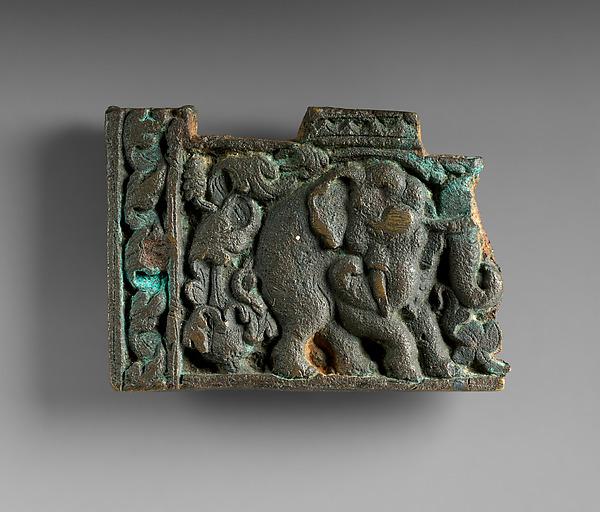
Fragment of a Box (?) with Elephants
Measurements
2 1/8 x 1 9/16 x 1/4 in. (5.4 x 4 x 0.6 cm)
Creation Date
ca. 5th century, Gupta period
Credit Line
Gift of Florence and Herbert Irving, 2015
Culture
Country of Origin
Object Type
Materials / Techniques
Object URL
http://www.metmuseum.org/art/collection/search/37670
Provenance Information
Purchased from Douglas McDougall, New York, in 1989, by Herbert and Florence Irving, New York; Collection of Florence and Herbert Irving from 1989 through 2015; Gift of Florence and Herbert Irving to The Metropolitan Museum of Art in 2015.
Exhibition Information
On view from February 1994 until May 2007 in the Florence and Herbert Irving Galleries for the Arts of South and Southeast Asia at The Metropolitan Museum of Art.
Publication Information
Published on The Metropolitan Museum of Art’s online collection database (http://www.metmuseum.org/art/collection) as of July 2015.
Section of the AAMD Guidelines relied upon for the exception to 1970
Gift or bequest expected or on loan prior to 2008
Explain why the object fits the exception set forth above
The box fragment has been on loan to The Metropolitan Museum of Art since 1993. It was on exhibition in the Florence and Herbert Irving Galleries for the Arts of South and Southeast Asian Art for fourteen years.

2015.595

Object Title
Upper Part of a Hippo Goddess
Measurements
H. 16.5 cm (6 1/2 in.); W. 12.9 cm (5 1/16 in.); D. 11.5 cm (4 1/2 in.)
Creation Date
2649–2528 BC
Credit Line
Purchase, Mr. and Mrs. John A. Moran Gift, 2015
Culture
Country of Origin
Object Type
Materials / Techniques
Object URL
http://www.metmuseum.org/art/collection/search/694156
Provenance Information
Purchased from Lucien Viola of the Galerie l'Ibis, who acquired the piece with many others from the Egyptian antiquities inventory of Ernst Kofler. Kofler was a dealer, prinicpally of Egyptian art in the 1950's and 1960's, that Viola had known for many years in Cairo. Documentation dating to 1989 from Kofler states that he had owned for 20 years the group of antiquities, of which the hippo goddess was one, consigned to Viola for sale in 1987.
Exhibition Information
This work was exhibited in connection with the 2014 Brussels Ancient Art Fair
Publication Information
Christies London sale catalogue, April 12, 2000, lot 79, “A Rare Limestone Upper Part of a Statue of Taweret (Tueris).” The work was published (with photograph) in connection with the 2014 Brussels Ancient Art Fair. The work was also published as the signature image for the Galerie L’Ibis online catalog in 2014 and 2015.
Section of the AAMD Guidelines relied upon for the exception to 1970
Informed judgement that works were outside of the country of modern discovery before 1970
Explain why the object fits the exception set forth above
The Metropolitan Museum of Art has provenance information back to the early 1960s that is supported by circumstantial evidence. Ernst Kofler was a Swiss dealer who acquired works in Egypt through his friend, Maguid Sameda, in the 1950s and 1960s. After Mr. Sameda died in the late 1960s, Mr. Kofler stopped collecting Egyptian objects. In 1987, Lucien Viola met and later married Mr. Kofler’s granddaughter. Mr. Kofler transferred Egyptian objects, including this statuette, to Mr. Viola for sale during the late 1980’s. Mr. Kofler signed a certification dated February 25, 1983, declaring that all of the Egyptian reliefs and statues he gave to Mr. Viola for sale had been with Mr. Kofler “for over 20 years in Lausanne, Switzerland.” In 1987, this work was listed in a shipping invoice before its transfer from Mr. Kofler to Mr. Viola Currently this statue is understood to be the earliest known three dimensional representation of a composite deity, a concept that was quintessentially Egyptian for its pantheon. This rare statue depicts an early hippo goddess where human, hippopotamus, crocodile and feline characteristics are combined into a single deity.

2016.496.1

Object Title
Terracotta statuette of a goddess
Measurements
24 13/16 in. (63 cm)
Creation Date
mid to late 2nd century B.C.
Credit Line
Gift of Thomas Colville, 2016
Culture
Object Type
Materials / Techniques
Object URL
http://www.metmuseum.org/art/collection/search/659501
Provenance Information
Purchased through Sotheby’s, New York, February 8th,1985, lot 96; from 1985, collection of Thomas Colville, Guilford, CT; from 2014, on loan to The Metropolitan Museum of Art; given to The Metropolitan Museum of Art by Thomas Colville in 2016.
Exhibition Information
The Coroplast’s Art: Greek Terracottas of the Hellenistic World, The Art Museum, Princeton University, September 22 to December 30, 1990; College Art Gallery, The College at New Paltz, State University of New York, February 9 to March 15,1991; and The Arthur M. Sackler Museum, Harvard University, May 26 to July 28, 1991. On display at The Metropolitan Museum of Art since 2014.
Publication Information
1985. Antiquities and Islamic Art. February 8–9, 1985. lot 96.

Uhlenbrock, Jaimee. 1990. The Coroplast's Art: Greek Terracottas of the Hellenistic World no. 23, p. 134, pl. 3, New Rochelle, N.Y.: College Art Gallery, SUNY, New Paltz.

Picón, Carlos A. and Seán Hemingway. 2016. Pergamon and the Hellenistic Kingdoms of the Ancient World no. 77, p. 165, New York: The Metropolitan Museum of Art.

Karoglou, Kyriaki. 2016. "The Collection of Greek Terracotta Figurines at The Metropolitan Museum of Art." Les Carnets de l’ACoSt, 14: pp. 5–6, n. 31 [p.8], fig. 9.

Karoglou, Kyriaki. 2016. "Recent Acquisitions, A Selection: 2014–2016." The Metropolitan Museum of Art Bulletin, : p. 14.
Section of the AAMD Guidelines relied upon for the exception to 1970
Informed judgement that works were outside of the country of modern discovery before 1970
Explain why the object fits the exception set forth above
This work has confirmed provenance to 1985 when it was sold at auction to its prior owner. This large statuette belongs to a class of statuettes produced to imitate or echo monumental sculptures in bronze or marble. Its large scale, ornate baroque style and quality of execution point to a major colorplastic workshop in Asia Minor, probably Myrina. Although the museum has an outstanding collection of Greek terracottas, this example is an important addition because of its large scale, rich drapery, unusual iconography, excellent preservation, and quality of execution.
Subscribe to Sculpture