Home

2016.701

Object Title
Crowned Bodhisattva
Measurements
H. 16 3/4 in. (42.5 cm); W. 13 in. (33 cm); D. 6 1/2 in. (16.5 cm)
Creation Date
Late Kushan, 3rd century
Credit Line
Purchase, The Fred Eychaner Charitable Fund Gift, in honor of John Guy, 2016
Country of Origin
Object Type
Materials / Techniques
Object URL
http://www.metmuseum.org/art/collection/search/38634
Provenance Information
Purchased from Moonsail Ltd, Middlesex, UK, by Jeffrey B. Soref on November 26, 1982; Collection of Jeffrey B. Soref from 1982 to 2016; Purchased from Jeffrey B. Soref by The Metropolitan Museum of Art in 2016.
Exhibition Information
The work has been on loan to and on display at The Metropolitan Museum of Art since 1994.
Publication Information
None
Section of the AAMD Guidelines relied upon for the exception to 1970
Gift or bequest expected or on loan prior to 2008
Explain why the object fits the exception set forth above
The work has been on loan to and on display at the Metropolitan Museum for 22 years (1994-2016). This upper section of a standing Bodhisattva figure is a rare and iconographically important work of the Mathuran school of Buddhist art.

2016.700

Object Title
Buddha
Measurements
H. 30 in. (76.2 cm); W. 11 in. (27.9 cm); D. 4 1/2 in. (11.4 cm)
Creation Date
Ikshvaku period (ca. 225–ca. 320), 3rd century
Credit Line
Purchase, The Vincent Astor Foundation Gift, Brooke Russell Astor Bequest, The Miriam and Ira D. Wallach Foundation Fund; Fernando Family Trust Gift, in honor of Dr. Quintus and Mrs. Wimala Fernando; Vijay K. Anand, M.D., Nanda Anand, Maya Anand, and Rohi
Culture
Country of Origin
Object Type
Materials / Techniques
Object URL
http://www.metmuseum.org/art/collection/search/38237
Provenance Information
Purchased from David Tremayne Ltd, London, by Jeffrey B. Soref on February 13, 1987; Collection of Jeffrey B. Soref from 1987 through 2016; Purchased from Jeff Soref by The Metropolitan Museum of Art in 2016.
Exhibition Information
The work has been on loan to and on display at The Metropolitan Museum of Art since 1994.
Publication Information
None
Section of the AAMD Guidelines relied upon for the exception to 1970
Gift or bequest expected or on loan prior to 2008
Explain why the object fits the exception set forth above
Explain why the object fits the exception set forth above: The work has been on loan to and displayed at the Metropolitan Museum for 22 years (1994-2016). This work is a keystone work, linking the figurative tradition of Andhra to the traditions practiced in India’s north and north-west.
 

2015.782.1

Object Title
Enthroned Buddha Finial
Measurements
H. 4 3/8 in. (11.1 cm); W. 2 1/8 in. (5.4 cm); D. 1 1/4 in. (3.2 cm)
Creation Date
4th–5th century
Credit Line
Gift of Jeff Soref and Paul Lombardi, in honor of Natalie Soref, 2015
Culture
Country of Origin
Object Type
Materials / Techniques
Object URL
http://www.metmuseum.org/art/collection/search/705433
Provenance Information
Reportedly in the Rubin Collection before 1982; Collection of Jeffrey B. Soref from at least 1982 to 2015; Gift of Jeff Soref and Paul Lombardi to The Metropolitan Museum of Art in 2015.
Exhibition Information
The work was exhibited at The Metropolitan Museum of Art in 1982 in the exhibition Along the Ancient Silk Roads.
Publication Information
U. Von Schroeder, Indo-Tibetan Bronzes, Hong Kong, Visual Dharma Publications, 1981, p. 79, pl. 3D.
Section of the AAMD Guidelines relied upon for the exception to 1970
Cumulative facts and circumstances
Explain why the object fits the exception set forth above
The work has provenance established to 1981 when it was published in Von Schroeder as from a “Private Collection, photo courtesy of The Metropolitan Museum of Art.” The work was exhibited at the Metropolitan Museum in 1982. A diminutive image of a Buddha in meditation, on a lotus petal waisted pedestal, framed by a pearl-bordered aureole. The distinctive folds of the upper robe, pleated with V-front in a style familiar from late Kushan stone versions of this subject, points to an early date for Gandharan metal imagery, perhaps 4th century. The early date assigned to this work adds to its significance. The Museum has the premier collection of Gandharan art in the United States, including a uniquely important early bronze seated Buddha and bronze reliquary. This finial depiction of the Buddha lies in direct descent from such early works, and allows the Metropolitan Museum to demonstrate to the public the way in which early Buddha imagery evolved over these early centuries.

2015.782.2

Object Title
Seated Protective Buddha
Measurements
H. 2 15/16 in. (7.5 cm)
Creation Date
second half 6th century
Credit Line
Gift of Jeff Soref and Paul Lombardi, in honor of Natalie Soref, 2015
Country of Origin
Object Type
Materials / Techniques
Object URL
http://www.metmuseum.org/art/collection/search/705432
Provenance Information
By 1978, Private Collection, Chicago. Sold at Sotheby’s London, November 14, 1988, lot 66; Offered at Sotheby’s on March 21, 2012, as Property of a European Collector; Purchased at Sotheby’s by Jeffrey B. Soref on March 21, 2012; Gift of Jeff Soref and Paul Lombardi to The Metropolitan Museum of Art in 2015.
Exhibition Information
The work was exhibited in the 1978 exhibition The Ideal Image: The Gupta Sculptural Tradition and its Influence at the Asia Society, New York, at the Art Institute of Chicago from 1980 to 1985, and in 2014 at The Metropolitan Museum in Lost Kingdoms.
Publication Information
Thanphong Kridakon, Pramuan phap pratima [A Collection of Sculptures], 1965, no. 3; P. Pal, The Ideal Image: The Gupta Sculptural Tradition and its Influence, 1978, p. 122, no .76, and exhibited; Rhie, Marylin M. Interrelationships Between the Buddhist Art of China and the Art of India and Central Asia from 618–755 A.D. Supplemento n. 54 agli Annali, vol. 48 (1988) fasc. 1. Napoli: Instituto universitario orientale, 1988: 42, fig. 66; Sotheby’s London, November 14, 1988, lot 66; Sotheby’s NY, 21 March 2012, lot 242; J. Guy, Lost Kingdoms, MMA, 2014, p. 76, cat. 23, and exhibited.
Section of the AAMD Guidelines relied upon for the exception to 1970
Cumulative facts and circumstances
Explain why the object fits the exception set forth above
This work was first published in a Thai publication in 1965. The work has provenance established to 1978, when it was exhibited and published with an accompanying description and photograph in the catalog. The work was exhibited from 1980 to 1985 at the Art Institute of Chicago, and it was published in 2012 when it was offered for sale at auction by Sotheby’s. It was exhibited and published by the Metropolitan Museum in the 2014 exhibition Lost Kingdoms. This miniature icon of a Buddha expounding the dharma has the distinction of being among the earliest renderings of this subject known from Mon territories. The preaching Buddha seated with pendant legs became the signature icon of the monumental stupas built by the Mon state in 8th century central Thailand. The importance of this miniature icon of a Buddha lies in both its serving as an early prototype for such monumental Buddhas, and the likelihood that it is the earliest version of this subject known.

2017.7

Object Title
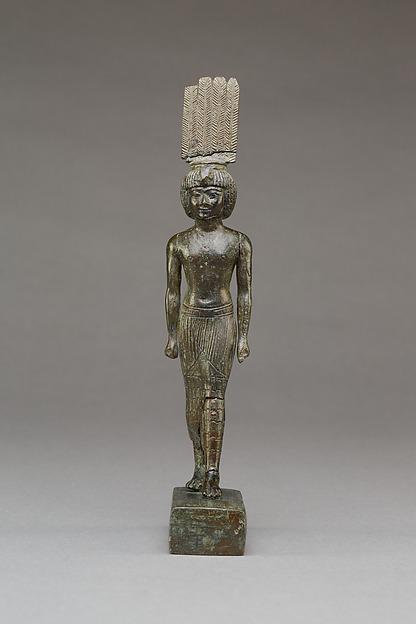
Onuris
Measurements
H. 17.5 × W. 3.4 × D. 6.4 cm (6 7/8 × 1 5/16 × 2 1/2 in.)
Creation Date
Third Intermediate Period, probably, 1070–664 BC
Credit Line
Purchase, Liana Weindling Gift, 2017
Culture
Country of Origin
Object Type
Materials / Techniques
Object URL
http://www.metmuseum.org/art/collection/search/736189
Provenance Information
Probably Collection of Countess Behague (d. 1939); thereafter by descent to Marquis de Ganay (Hubert, d. 1974, her nephew); consigned to Jean-Philippe Mariaud de Serres (d. 2007); purchased from Mariaud de Serres by W. Arnold Meijer, Netherlands, 1997; Collection of W. Arnold Meijer, 1997-2016; purchased by The Metropolitan Museum of Art, 2016
Exhibition Information
Allard Pierson Museum, Archaeological Museum of the University of Amsterdam, November 17, 2006, through March 25, 2007, and published in the catalog of that exhibition.
Publication Information
Objects for Eternity, Egyptian Antiquities from the W. Arnold Meijer Collecion, Carol A.R. Andrews and Jacobus van Dijk, Mainz 2006, No. 3.01 pp. 166-8 and 258.
Section of the AAMD Guidelines relied upon for the exception to 1970
Informed judgement that works were outside of the country of modern discovery before 1970
Explain why the object fits the exception set forth above
This work has provenance reported to the early 1900s, but the Museum has been unable to independently verify the documentation. The work was acquired by W. Arnold Meijer in 1997 and published and exhibited in 2006. This very beautiful figure represents the fascinating and important god Onuris in a way the Metropolitan Museum’s two other examples cannot. The statuette is a fine and elegant casting and presents stylistic and technological features that are associated with the earliest period of regular bronze production in Egypt.

Head of Vaitunkta Vishnu

Object Title
2014.688
Measurements
H. 6 5/16 in. (16 cm); W. 5 3/8 in. (13.7 cm); D. 4 1/2 in. (11.4 cm)
Creation Date
ca. 6th century
Credit Line
Purchase, Anonymous Gift, 2014
Culture
Country of Origin
Object Type
Materials / Techniques
Object URL
http://www.metmuseum.org/art/collection/search/646747
Provenance Information
Acquired on the London market by Simon Digby (b. 1932–d. 2010) in the 1970s; Collection of Simon Digby, Jersey Island, United Kingdom; Purchased by The Metropolitan Museum of Art from the Estate of Simon Digby through John Sidumak in 2014.
Exhibition Information
Exhibited in Asia Week, 2014, Indian and Himalayan Sculpture, John Siudmak at Boerner Gallery, 23 East 73rd Street, New York, New York.
Publication Information
Indian and Himalayan Sculpture, John Siudmak, sale catalogue, 2014, pp. 14–15.
Section of the AAMD Guidelines relied upon for the exception to 1970
Cumulative facts and circumstances
Explain why the object fits the exception set forth above
This work was acquired in London in the 1970s and remained in the Collection of Simon Digby until its acquisition by the Metropolitan Museum. Simon Digby, who was born in India to English parents, was a former curator of the Ashmolean Museum and later an independent scholar. This Head of Vaitunkta Vishnu comes from a region in what is today northern Pakistan. The work is likely associated with the Brahmanical mountain complex known as Kashmir Smast, active in the 6th–early 7th century. The iconography represented by works from this site has been of seminal importance in building scholars’ understanding of the evolution of Brahmanical imagery in north-western India generally. Although small in scale, this head of Vishnu represents an important historical moment in the region’s history, witnessed by a shift from Indian Gupta-type crowns to one of Sasanian inspiration, reflecting 6th century regional political re-alliances. It allows a greater understanding of early Vishnu imagery from the northwestern region of the subcontinent.

2014.687

Object Title
Head of Addorsed Maheshvara
Measurements
H. 5 1/8 in. (13 cm); W. 5 1/4 in. (13.3 cm); D. 3 1/4 in. (8.3 cm)
Creation Date
ca. 6th century
Credit Line
Purchase, Anonymous Gift, 2014
Culture
Country of Origin
Object Type
Materials / Techniques
Object URL
http://www.metmuseum.org/art/collection/search/646746
Provenance Information
Acquired on the London market by Simon Digby (b. 1932–d. 2010) in the 1970s; Collection of Simon Digby, Jersey Island, United Kingdom; Purchased by The Metropolitan Museum of Art from the Estate of Simon Digby through John Siudmak in 2014.
Exhibition Information
Exhibited in Asia Week, 2014, Indian and Himalayan Sculpture, John Siudmak at Boerner Gallery, 23 East 73rd Street, New York, New York.
Publication Information
Indian and Himalayan Sculpture, John Siudmak, sale catalogue, 2014, pp. 14–15.
Section of the AAMD Guidelines relied upon for the exception to 1970
Cumulative facts and circumstances
Explain why the object fits the exception set forth above
This work was acquired in London in the 1970s and remained in the Collection of Simon Digby until its acquisition by the Metropolitan Museum. Simon Digby, who was born in India to English parents, was a former curator of the Ashmolean Museum and later an independent scholar. This Head of Addorsed Maheshvara comes from a region in what is today northern Pakistan. The work is likely associated with the Brahmanical mountain complex known as Kashmir Smast, active in the 6th–early 7th century. The iconography represented by works from this site has been of seminal importance in building scholars’ understanding of the evolution of Brahmanical imagery in north-western India generally. Although small in scale, this work nonetheless represents an important early stage in the esoteric iconographic development of Shiva, which is otherwise unrepresented in the Museum’s holdings, thus allowing a greater understanding of early Saiva imagery from the northwestern region of the subcontinent.

2014.686

Object Title
Head of Shiva
Measurements
H. 4 3/4 in. (12 cm); W. 3 1/2 in. (8.9 cm); D. 3 3/8 in. (8.6 cm)
Creation Date
ca. 6th century
Credit Line
Purchase, Lindemann Fund and Anonymous Gift, 2014
Culture
Country of Origin
Object Type
Materials / Techniques
Object URL
http://www.metmuseum.org/art/collection/search/646745
Provenance Information
Acquired on the London market by Simon Digby (b. 1932–d. 2010) in the 1970s; Collection of Simon Digby, Jersey Island, United Kingdom; Purchased by The Metropolitan Museum of Art from the Estate of Simon Digby through John Siudmak in 2014.
Exhibition Information
Exhibited in Asia Week, 2014, Indian and Himalayan Sculpture, John Siudmak at Boerner Gallery, 23 East 73rd Street, New York, New York.
Publication Information
Indian and Himalayan Sculpture, John Siudmak, sale catalogue, 2014, pp. 12–13.
Section of the AAMD Guidelines relied upon for the exception to 1970
Cumulative facts and circumstances
Explain why the object fits the exception set forth above
This work was acquired in London in the 1970s and remained in the Collection of Simon Digby until its acquisition by the Metropolitan Museum. Simon Digby, who was born in India to English parents, was a former curator of the Ashmolean Museum and later an independent scholar. This Head of Shiva comes from a region in what is today northern Pakistan. The work is likely associated with the Brahmanical mountain complex known as Kashmir Smast, active in the 6th–early 7th century. The iconography represented by works from this site has been of seminal importance in building scholars’ understanding of the evolution of Brahmanical imagery in north-western India generally. Though small in scale, this work nonetheless represents an important early stage in stylistic development which is otherwise unrepresented in the Museum’s holdings, thus allowing a greater understanding of early Saiva imagery from the northwestern region of the subcontinent.

2016.422

Object Title
Head of Buddha Shakyamuni
Measurements
42.0 x 30.5 x 31.2 cm (16 5/8 x 12 x 12 5/16 in.)
Creation Date
7th/8th century
Credit Line
Gift of Marilynn B. Alsdorf
Country of Origin
Object Type
Materials / Techniques
Museum's Definition of Antiquity
Created before 800 CE
Provenance Information
Purchased by Mr. James W. Alsdorf, Chicago, Illinois, U.S.A. The exact date that Mr. Alsdorf purchased this object is unknown; however, Mr. Alsdorf acquired the object by 1983 when he placed it on long-term loan at the Art Institute of Chicago. Attempts to determine from whom Mr. Alsdorf acquired the object were unsuccessful. Mrs. Marilynn Alsdorf publicly promised the object to the Art Institute of Chicago in 1997, signed a promised gift agreement for the object in 2002, and gave the object to the Art Institute of Chicago in 2016.
Exhibition Information
A Collecting Odyssey: Indian, Himalayan, and Southeast Asian Art from the James and Marilynn Alsdorf Collection, The Art Institute of Chicago, Chicago, Illinois (August 2 – October 26, 1997).


The object has been displayed at the Art Institute of Chicago, Chicago, Illinois, from March 2003 to October 2003.
Publication Information
Pal, Pratapaditya with contributions by Stephen Little, A Collecting Odyssey: Indian, Himalayan, and Southeast Asian Art from the James and Marilynn Alsdorf Collection. Chicago: The Art Institute of Chicago in association with Thames and Hudson, New York, (1997), p. 299: cat. 121 and plate p. 101.
Section of the AAMD Guidelines relied upon for the exception to 1970
Cumulative facts and circumstances
Explain why the object fits the exception set forth above
Cumulative facts and circumstances.
Gift or bequest expected or on loan prior to 2008.
This acquisition falls within two exceptions. First, the cumulative facts and circumstances known to the Art Institute of Chicago at the time of the acquisition allowed it to make an informed judgment to acquire the object. The exact date that Mr. Alsdorf purchased this object is unknown; however, Mr. Alsdorf acquired the object by 1983 when he placed it on long-term loan at the Art Institute of Chicago. Attempts to determine from whom Mr. Alsdorf acquired the object were unsuccessful. The object has been exhibited at the Art Institute of Chicago in 2003 and 1997 and published in a major catalogue of South Asian art: A Collecting Odyssey: Indian, Himalayan, and Southeast Asian Art from the James and Marilynn Alsdorf Collection (1997). In addition, the acquisition furthers the representation of the artistic achievements of all civilizations in art museums because it represents the head of Buddha Shakyamuni from the Mon-Dvaravati culture that flourished in ancient Thailand and reveals the cultural interaction between India and Thailand in antiquity.
Second, the acquisition of the object was by gift and promised to the Art Insittute prior to 2008. Mrs Alsdorf publicly promised the object to the Art Institute of Chicago in 1997 and thereafter signed a promised gift agreement for the object in 2002.

2016.433

Object Title
Buddha with Hand in Gesture of Teaching (Vitarkamudra)
Measurements
52.0 x 15.1 x 12.4 cm (20 1/4 x 4 7/8 in.)
Creation Date
8th century
Credit Line
Gift of Marilynn B. Alsdorf
Country of Origin
Object Type
Materials / Techniques
Museum's Definition of Antiquity
Created before 800 CE
Provenance Information
Purchased by Mr. James W. Alsdorf, Chicago, Illinois, U.S.A. The exact date that Mr. Alsdorf purchased this object is unknown; based on the exhibition history, Mr. Alsdorf acquired the object by 1978. Mr. Alsdorf may have acquired the object in 1968 from Otto Schoener, Germany, although attempts to determine this conclusively were unsucessful. Mrs. Marilynn Alsdorf publicly promised the object to the Art Institute of Chicago in 1997, signed a promised gift agreement for the object in 2002, and gave the object to the Art Institute in 2016.
Exhibition Information

The Ideal Image, The Asia House Gallery, New York, Fall 1978, The Art Institute of Chicago, (March 24 – May 1979).

Light of Asia: Buddha Sakyamuni in Asian Art, Los Angeles County Museum of Art, (March 4 – May 20, 1984); The Art Institute of Chicago, (June 30 – August 26, 1984); The Brooklyn Museum, (November 1, 1984 – February 10, 1985).

A Collecting Odyssey: Indian, Himalayan, and Southeast Asian Art from the James and Marilynn Alsdorf Collection, The Art Institute of Chicago, Chicago, Illinois (August 2 – October 26, 1997).

In the Footsteps of the Buddha, University Museum and Art Gallery, Hong Kong, China, (September 25 – December 15, 1998).

The object has been displayed at the Art Institute of Chicago, Chicago, Illinois, from 1999 to 2005 and in the Alsdorf Galleries of Indian, Southeast Asian, Himalayan and Islamic Art, from December 2008 to the present.
Publication Information
Ghose, Rajeshwari, In the Footsteps of the Buddha: An Iconic Journey from India to China, Hong Kong: University Museum and Art Gallery, The University of Hong Kong, (1998), Plate 44.

Little, Stephen, "Southeast Asian Sculptures from the James and Marilynn Alsdorf Collection." Orientations 28, no. 7 (July – August 1997), p. 61: fig. 9.

Pal, Pratapaditya, “A Collecting Odyssey. Reflections on the Alsdorf Collection”. Arts of Asia, vol. 27, no. 5 (September – October 1997): fig. 17.

Pal, Pratapaditya with contributions by Stephen Little, A Collecting Odyssey: Indian, Himalayan, and Southeast Asian Art from the James and Marilynn Alsdorf Collection. Chicago: The Art Institute of Chicago in association with Thames and Hudson, New York, (1997), p. 299, cat. 123, pl. p. 103.

Pal, Pratapaditya (organizer, with contributing authors), Light of Asia: Buddha Sakyamuni in Asian Art, Los Angeles county Museum of Art, (1984) p. 219.

Pal, Pratapaditya, The Ideal Image. NY: The Asia Society, (1978), Plate 83.
Section of the AAMD Guidelines relied upon for the exception to 1970
Cumulative facts and circumstances
Explain why the object fits the exception set forth above
Cumulative facts and circumstances.
Gift or bequest expected or on loan prior to 2008.
This acquisition falls within two exceptions. First, the cumulative facts and circumstances known to the Art Institute of Chicago at the time of the acquisition allowed it to make an informed judgment to acquire the object. The exact date that Mr. Alsdorf purchased this object is unknown; based on the exhibition history, Mr. Alsdorf acquired the object by 1978. Mr. Alsdorf may have acquired the object in 1968 from Otto Schoener, Germany, although attempts to determine this conclusively were unsucessful. The work was included in multiple exhibitions in New York, Chicago, Los Angeles and Hong Kong and has been publicly displayed from 1999 to 2005 and again since December 2008 at the Art Institute of Chicago. It has been published multiple times, including in three catalogues of South Asian art: Light of Asia (1984), A Collecting Odyssey: Indian, Himalayan, and Southeast Asian Art from the James and Marilynn Alsdorf Collection (1997); and In the Footsteps of the Buddha (1998). In addition, the acquisition furthers the representation of the artistic achievements of all civilizations in art museums because it is an important example of a bronze Buddha from the Mon-Dvaravati culture showing the interaction between India and Thailand in antiquity.
Second, the acquisition of the object was by gift and the object was promised to the Art Insittute prior to 2008. Mrs Alsdorf publicly promised the object to the Art Institute of Chicago in 1997 and thereafter signed a promised gift agreement for the object in 2002.
Subscribe to Sculpture