Home

Head of Vaitunkta Vishnu

Object Title
2014.688
Measurements
H. 6 5/16 in. (16 cm); W. 5 3/8 in. (13.7 cm); D. 4 1/2 in. (11.4 cm)
Creation Date
ca. 6th century
Credit Line
Purchase, Anonymous Gift, 2014
Culture
Country of Origin
Object Type
Materials / Techniques
Object URL
http://www.metmuseum.org/art/collection/search/646747
Provenance Information
Acquired on the London market by Simon Digby (b. 1932–d. 2010) in the 1970s; Collection of Simon Digby, Jersey Island, United Kingdom; Purchased by The Metropolitan Museum of Art from the Estate of Simon Digby through John Sidumak in 2014.
Exhibition Information
Exhibited in Asia Week, 2014, Indian and Himalayan Sculpture, John Siudmak at Boerner Gallery, 23 East 73rd Street, New York, New York.
Publication Information
Indian and Himalayan Sculpture, John Siudmak, sale catalogue, 2014, pp. 14–15.
Section of the AAMD Guidelines relied upon for the exception to 1970
Cumulative facts and circumstances
Explain why the object fits the exception set forth above
This work was acquired in London in the 1970s and remained in the Collection of Simon Digby until its acquisition by the Metropolitan Museum. Simon Digby, who was born in India to English parents, was a former curator of the Ashmolean Museum and later an independent scholar. This Head of Vaitunkta Vishnu comes from a region in what is today northern Pakistan. The work is likely associated with the Brahmanical mountain complex known as Kashmir Smast, active in the 6th–early 7th century. The iconography represented by works from this site has been of seminal importance in building scholars’ understanding of the evolution of Brahmanical imagery in north-western India generally. Although small in scale, this head of Vishnu represents an important historical moment in the region’s history, witnessed by a shift from Indian Gupta-type crowns to one of Sasanian inspiration, reflecting 6th century regional political re-alliances. It allows a greater understanding of early Vishnu imagery from the northwestern region of the subcontinent.

2014.687

Object Title
Head of Addorsed Maheshvara
Measurements
H. 5 1/8 in. (13 cm); W. 5 1/4 in. (13.3 cm); D. 3 1/4 in. (8.3 cm)
Creation Date
ca. 6th century
Credit Line
Purchase, Anonymous Gift, 2014
Culture
Country of Origin
Object Type
Materials / Techniques
Object URL
http://www.metmuseum.org/art/collection/search/646746
Provenance Information
Acquired on the London market by Simon Digby (b. 1932–d. 2010) in the 1970s; Collection of Simon Digby, Jersey Island, United Kingdom; Purchased by The Metropolitan Museum of Art from the Estate of Simon Digby through John Siudmak in 2014.
Exhibition Information
Exhibited in Asia Week, 2014, Indian and Himalayan Sculpture, John Siudmak at Boerner Gallery, 23 East 73rd Street, New York, New York.
Publication Information
Indian and Himalayan Sculpture, John Siudmak, sale catalogue, 2014, pp. 14–15.
Section of the AAMD Guidelines relied upon for the exception to 1970
Cumulative facts and circumstances
Explain why the object fits the exception set forth above
This work was acquired in London in the 1970s and remained in the Collection of Simon Digby until its acquisition by the Metropolitan Museum. Simon Digby, who was born in India to English parents, was a former curator of the Ashmolean Museum and later an independent scholar. This Head of Addorsed Maheshvara comes from a region in what is today northern Pakistan. The work is likely associated with the Brahmanical mountain complex known as Kashmir Smast, active in the 6th–early 7th century. The iconography represented by works from this site has been of seminal importance in building scholars’ understanding of the evolution of Brahmanical imagery in north-western India generally. Although small in scale, this work nonetheless represents an important early stage in the esoteric iconographic development of Shiva, which is otherwise unrepresented in the Museum’s holdings, thus allowing a greater understanding of early Saiva imagery from the northwestern region of the subcontinent.

2014.686

Object Title
Head of Shiva
Measurements
H. 4 3/4 in. (12 cm); W. 3 1/2 in. (8.9 cm); D. 3 3/8 in. (8.6 cm)
Creation Date
ca. 6th century
Credit Line
Purchase, Lindemann Fund and Anonymous Gift, 2014
Culture
Country of Origin
Object Type
Materials / Techniques
Object URL
http://www.metmuseum.org/art/collection/search/646745
Provenance Information
Acquired on the London market by Simon Digby (b. 1932–d. 2010) in the 1970s; Collection of Simon Digby, Jersey Island, United Kingdom; Purchased by The Metropolitan Museum of Art from the Estate of Simon Digby through John Siudmak in 2014.
Exhibition Information
Exhibited in Asia Week, 2014, Indian and Himalayan Sculpture, John Siudmak at Boerner Gallery, 23 East 73rd Street, New York, New York.
Publication Information
Indian and Himalayan Sculpture, John Siudmak, sale catalogue, 2014, pp. 12–13.
Section of the AAMD Guidelines relied upon for the exception to 1970
Cumulative facts and circumstances
Explain why the object fits the exception set forth above
This work was acquired in London in the 1970s and remained in the Collection of Simon Digby until its acquisition by the Metropolitan Museum. Simon Digby, who was born in India to English parents, was a former curator of the Ashmolean Museum and later an independent scholar. This Head of Shiva comes from a region in what is today northern Pakistan. The work is likely associated with the Brahmanical mountain complex known as Kashmir Smast, active in the 6th–early 7th century. The iconography represented by works from this site has been of seminal importance in building scholars’ understanding of the evolution of Brahmanical imagery in north-western India generally. Though small in scale, this work nonetheless represents an important early stage in stylistic development which is otherwise unrepresented in the Museum’s holdings, thus allowing a greater understanding of early Saiva imagery from the northwestern region of the subcontinent.

2015.260.3!

Object Title
Gilt silver phiale mesomphalos
Measurements
Diameter: 8 in. (20.3 cm) Height: 1 1/4 in. (3.2 cm)
Creation Date
late 5th century B.C.
Credit Line
Gift of Mary and Michael Jaharis in honor of Director Thomas P. Campbell, 2015
Culture
Object Type
Materials / Techniques
Object URL
http://www.metmuseum.org/collection/the-collection-online/search/646264
Provenance Information
[By 2001, with Ariadne Galleries, New York and London]; 2001, purchased by Mary and Michael Jaharis from Ariadne Galleries, New York; 2001-2015, collection of Mary and Michael Jaharis, New York; acquired in 2015, gift of Mary and Michael Jaharis in honor of Thomas P. Campbell.
Exhibition Information
This work was exhibited while on loan at the Metropolitan Museum beginning in June 2014.
Publication Information
None.
Section of the AAMD Guidelines relied upon for the exception to 1970
Cumulative facts and circumstances
Explain why the object fits the exception set forth above
Silver plate was used throughout the ancient Greek world in the Classical period, although very little survives. Even rarer are the so-called “gold-figure” vessels, which have been predominantly found on the north-eastern fringes of the Hellenized world in ancient Thrace and the ancient Bosporan kingdom. On this beautifully preserved libation vessel, four youths hunt deer on horseback with spears. The artist makes clever use of the circular shape to show the hunters encircling their quarry.

2015.260.2

Object Title
Gilt silver kylix
Measurements
Diameter: 5 1/8 in. (13 cm) Width: 7 1/8 in. (18.1 cm) Height: 1 13/16 in. (4.6 cm)
Creation Date
late 5th century B.C.
Credit Line
Gift of Mary and Michael Jaharis in honor of Director Thomas P. Campbell, 2015
Culture
Object Type
Materials / Techniques
Object URL
http://www.metmuseum.org/collection/the-collection-online/search/646263
Provenance Information
[By 2001, with Ariadne Galleries, New York and London]; 2001, purchased by Mary and Michael Jaharis from Ariadne Galleries, New York; 2001-2015, collection of Mary and Michael Jaharis, New York; acquired in 2015, gift of Mary and Michael Jaharis in honor of Thomas P. Campbell.
Exhibition Information
This work was exhibited while on loan at the Metropolitan Museum beginning in June 2014.
Publication Information
None.
Section of the AAMD Guidelines relied upon for the exception to 1970
Cumulative facts and circumstances
Explain why the object fits the exception set forth above
Silver plate was used throughout the ancient Greek world in the Classical period, although very little survives. Even rarer are the so-called “gold-figure” vessels, which have been predominantly found on the north-eastern fringes of the Hellenized world in ancient Thrace and the ancient Bosporan kingdom. This vessel is a particularly good example of this metalwork which is otherwise not represented in the Museum’s collection.

2015.260.1

Object Title
Gilt silver kylix
Measurements
Diameter: 6 11/16 in. (17 cm) Width: 8 13/16 in. (22.4 cm) Height: 1 3/4 in. (4.4 cm)
Creation Date
late fifth century B.C.
Credit Line
Gift of Mary and Michael Jaharis in honor of Director Thomas P. Campbell, 2015
Culture
Object Type
Materials / Techniques
Object URL
http://www.metmuseum.org/collection/the-collection-online/search/646262?rpp=30&pg=1&ft=2015.260.1&pos=1http://www.metmuseum.org/collection/the-collection-online/search/39126
Provenance Information
[By 2001, with Ariadne Galleries, New York and London]; 2003, purchased by Mary and Michael Jaharis from Ariadne Galleries, New York; 2003-2015, collection of Mary and Michael Jaharis, New York; acquired in 2015, gift of Mary and Michael Jaharis in honor of Thomas P. Campbell.
Exhibition Information
This work was exhibited while on loan at the Metropolitan Museum beginning in June 2014.
Publication Information
None.
Section of the AAMD Guidelines relied upon for the exception to 1970
Cumulative facts and circumstances
Explain why the object fits the exception set forth above
Silver plate was used throughout the ancient Greek world in the Classical period, although very little survives. Even rarer are the so-called “gold-figure” vessels, which have been predominantly found on the north-eastern fringes of the Hellenized world in ancient Thrace and the ancient Bosporan kingdom. This vessel is a particularly good example of this metalwork which is otherwise not represented in the Museum’s collection.

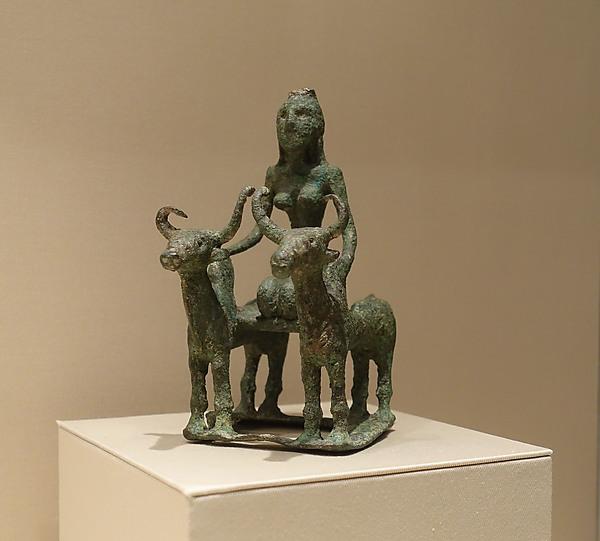
2015.505

Object Title
Woman Riding Two Brahman Bulls
Measurements
H. 5 1/8 in. (13 cm)
Creation Date
2000–1750 B.C.
Credit Line
Gift of Jonathan and Jeannette Rosen, 2015
Culture
Country of Origin
Object Type
Materials / Techniques
Object URL
http://www.metmuseum.org/collection/the-collection-online/search/39126
Provenance Information
With Samuel Eilenberg, New York, by 1991, when it was placed on loan to The Metropolitan Museum of Art; acquired from Mr. Eilenberg by Jonathan Rosen, New York, in 1993; it has been consistently displayed in the permanent galleries from 1991 through 2015; gift of Jonathan Rosen to The Metropolitan Museum of Art in 2015.
Exhibition Information
This work has been on long-term loan to, and on display at, The Metropolitan Museum of Art since 1991.
Publication Information
Martin Lerner and Steve Kossak, The Lotus Trascendent – Indian and Southeast Asian Art from the Samuel Eilenbeg Collection, New York, The Metropolitan Museum of Art/Abrams, 1991: 46-37.
Section of the AAMD Guidelines relied upon for the exception to 1970
Gift or bequest expected or on loan prior to 2008
Explain why the object fits the exception set forth above
This work has provenance to at least 1991 when Samuel Eilenberg offered it as a loan to The Metropolitan Museum of Art and it has been displayed continuously since then in the Museum’s galleries. The work has been published once in 1991. This exceedingly rare bronze figure is the oldest bronze object in the Museum’s Indian collections. It is a rare survivor of the early bronze culture associated with the Harappan civilization. This work represents a little understood aspect of early bronze culture in proto-historic India and adds to our understanding of early Brahamanical art in early northern India.

2015.306

Object Title
House Model
Measurements
H. 12 X W. 10 1/4 x D. 6 3/4 in. (30.5 x 26 x 17.1 cm)
Creation Date
100 B.C.–A.D. 200
Credit Line
Gift of Joanne P. Pearson, in memory of Andrall E. Pearson, 2015
Culture
Country of Origin
Object Type
Materials / Techniques
Object URL
http://www.metmuseum.org/collection/the-collection-online/search/319227
Provenance Information
Collection of Allan L. Long, New York, by 2000; Acquired by Ancient Art of the New World, New York, from Allan L. Long in 2000; Purchased from Ancient Art of the New World, New York, by Andrall E. and Joanne P. Pearson in September 2002; Collection of Andrall E. and Joanne P. Pearson, New York, 2002 to 2015; accepted as a promised gift from Mr. and Mrs. Pearson to The Metropolitan Museum of Art in 2004; given by Mr. and Mrs. Pearson to The Metropolitan Museum of Art in 2015.
Exhibition Information
This object was displayed at the Metropolitan Museum from October 19, 2004 through April 3, 2005 as part of the exhibition Heritage of Power: Ancient Sculpture from West Mexico. The Andrall E. Pearson Family Collection.
Publication Information
Kristi Butterwick, Heritage of Power: Ancient Sculpture from West Mexico. The Andrall E. Pearson Family Collection, New York, The Metropolitan Museum of Art/Yale University Press, 2004: 76-78.

Sarro, Patricia Joan, and James Doyle. "Monumental Imaginings in Mesoamerican Architectural Models." In Design for Eternity: Architectural Models from the Ancient Americas, edited by Joanne Pillsbury. New York: The Metropolitan Museum of Art, 2015, pp. 30–31, 38–39, figs. 27, 38, 39.
Section of the AAMD Guidelines relied upon for the exception to 1970
Gift or bequest expected or on loan prior to 2008
Explain why the object fits the exception set forth above
The work was accepted as a promised gift to The Metropolitan Museum of Art in 2004. The work was exhibited at the Metropolitan Museum from October 19, 2004 through April 3, 2005. This architecturally complex, ceramic structure features a feast for the dead with many intricate details. This model provides a rare opportunity to see architectural details that have not survived to the present day, such as plastered and painted thatched roofs. More importantly, the model depicts aspects of ritual and community life as ancient Nayarit artists conceived them. As such this work conveys a sense of place and activity in a way that few other objects do, an especially crucial feature for works of art from a region without contemporary texts.

2015.226a,b

Object Title
Teotihuacan-Style Hollow Figurine with Removable Chest Plate
Measurements
H. 14 3/4 x W. 10 5/8 in. (37.5 x 27 cm)
Creation Date
5th–7th century
Credit Line
Partial and Promised Gift of Linda M. Lindenbaum, from the Collection of Samuel H. and Linda M. Lindenbaum, 2015
Country of Origin
Object Type
Materials / Techniques
Object URL
http://www.metmuseum.org/collection/the-collection-online/search/684338
Provenance Information
Eduardo Paredes, Guatemala City, before July 1973; Edward H. Merrin Gallery, New York, until 1974; Mr. and Mrs. Samuel H. Lindenbaum, New York, partial gift, 1974–2015
Exhibition Information
Teotihuacan, Art from the City of the Gods [M.H. de Young Memorial Museum, San Francisco, 26 May – 31 October 1993], Cat. No. 66, pp. 214-215.
Publication Information
Hellmuth, Nicholas M. 1975. The Escuintla Hoards: Teotihuacan Art in Guatemala. F.L.A.A.R. Progress Reports vol. 1 no. 2, Plate 42A-B, p. 58. Photographs by Edwin Shook; Architectural Digest June 1981 (cover); Berjonneau, Gerald et al. Rediscovered Masterpieces of Mesoamerica. 1985. New York, Editions Arts. Photographs by Justin Kerr. Cat. No. 153, p. 118; Berrin, Kathleen, and Esther Pasztory, editors. 1993. Teotihuacan: Art from the City of the Gods. New York, Thames and Hudson. Cat. No. 66, pp. 214-215, 1994.
Section of the AAMD Guidelines relied upon for the exception to 1970
Cumulative facts and circumstances
Explain why the object fits the exception set forth above
This object was first photographed in 1973, first published in 1975 and featured in four subsequent publications, and was exhibited in 1993. This figurine comes from the Pacific Coast region of Guatemala, from which the Museum only has one other object. This style of “hollow” or “host” figurines found in Guatemala is indicative of the long-distance influence of the great Mexican city of Teotihuacan, the largest in the Precolumbian Americas. This successful and long-lasting center of merchants, artists, and others later became a site of pilgrimage for the Aztecs. These rare “host figures” were collected by artists such as Diego Rivera, and are considered among the most evocative images in Teotihuacan art. The proposed example is one of the largest and finest known.

2012.546

Object Title
Terracotta group of women seated around a well head
Measurements
Max. H.: 8 1/4 in. (21 cm)
Creation Date
2nd half of 4th century B.C.
Credit Line
Gift of Mary Jaharis, in honor of Thomas P. Campbell, 2012
Country of Origin
Object Type
Materials / Techniques
Object URL
http://www.metmuseum.org/collection/the-collection-online/search/257999?rpp=30&pg=1&ft=2012.546&pos=1
Provenance Information
[Until 1983, with The Merrin Gallery, Inc., New York]; 1983, purchased from Merrin Gallery by Christos G. Bastis; 1983-1999, collection of Christos G. Bastis, New York; December 9, 1999, purchased by Mary and Michael Jaharis at Sotheby’s auction of The Christos G. Bastis Collection, New York (lot 115); 1999-2012, collection of Mary and Michael Jaharis, New York; acquired by The Metropolitan Museum of Art in 2012, gift of Mr. and Mrs. Michael Jaharis.
Exhibition Information
The work was exhibited at The Metropolitan Museum of Art in 1987 as part of the Bastis Collection. The work has been on loan to, and on display at, The Metropolitan Museum of Art since 2007.
Publication Information
von Bothmer, Dietrich, Bernard V. Bothmer, Pat Getz-Preziosi, Diana Buitron-Oliver, and Andrew Oliver, Jr. 1987. Antiquities from the Collection of Christos G. Bastis, Emma Swan Hall, ed. no. 74, pp. 158-59, Mainz on Rhine: Verlag Philipp von Zabern.

Buitron-Oliver, Diana. 1987. "Terracottas." Antiquities from the Collection of Christos G. Bastis, Emma Swan Hall, ed. no. 74, pp. 158-59, Mainz: Verlag Philipp von Zabern.

The object was also published in the auction catalogue for Sotheby’s, New York, December 9, 1999, lot 115 (illustrated).

Karoglou, Kyriaki. 2014. "Recent Acquisitions, A Selection: 2012-2014." The Metropolitan Museum of Art Bulletin, 72(2): p. 8.
Section of the AAMD Guidelines relied upon for the exception to 1970
Gift or bequest expected or on loan prior to 2008
Explain why the object fits the exception set forth above
The work was exhibited at The Metropolitan Museum of Art in 1987 and again from 2007 to present. The work was sold at public auction in 1999. The work was published by The Metropolitan Museum of Art in 1987 as part of the Museum’s exhibition of the Bastis Collection and in the 1999 Sotheby’s auction catalogue. This is a rare group of South Italian terracotta figurines that functioned as a votive offering and /or an elaborate ritual implement such as an incense burner. There is – to Greek & Roman Department at The Metropolitan Museum of Art’s knowledge – no surviving parallel. The preservation of the original colors in particular is remarkable.
Subscribe to The Metropolitan Museum of Art