Home

2016.239

Object Title
Gold finger ring
Measurements
1/2 × 3/4 in. (1.3 × 1.9 cm) Other (Bezel): 7/16 × 3 1/4 in. (1.2 × 8.3 cm)
Creation Date
3rd century A.D., Late Imperial
Credit Line
Purchase, Patricia and Marietta Fried Gift, 2016
Culture
Country of Origin
Object Type
Materials / Techniques
Object URL
http://www.metmuseum.org/art/collection/search/712072
Provenance Information
Collection of Benjamin Zucker, New York, by 1985; purchased from Mr. Zucker through Les Enluminures by The Metropolitan Museum of Art, 2016.
Exhibition Information
Bedazzled: 5,000 Years of Jewelry, Frist Center for the Visual Arts, Nashville, Tenn. from Sept. 15, 2006, to Jan. 14, 2007; the John and Mable Ringling Museum of Art, Sarasota, Fla. from Feb. 18 to May 13, 2007; Walters Art Museum, October 19, 2008, to January 4, 2009.
Publication Information
Scarisbrick, Diana. 2007. Rings : Jewelry of Power, Love, and Loyalty. no. 81, p. 63, London: Thames and Hudson, London.

Hindman, Sandra, Beatriz Chadour-Sampson, Reine Hadjadj, Mr. Jack Ogden, and Diana Scarisbrick. 2014. Cycles of Life : Rings from the Benjamin Zucker Family Collection, Les Enluminures. no. 9, pp. 74–77, London: Paul Holberton Publishing.
Section of the AAMD Guidelines relied upon for the exception to 1970
Cumulative facts and circumstances
Explain why the object fits the exception set forth above
This work was placed on deposit at the Walters Art Museum from 1985 to 2013. It was displayed as part of the Walter’s traveling Bedazzled exhibition in 2007/8 and has been published twice. The Metropolitan Museum has some 25 Roman gold finger rings, mostly dated to the early imperial period. There is nothing comparable to this large and impressive Late Roman ring. It is significant not only in terms of its bulk but also for its use as a betrothal or wedding ring—a tradition that only became firmly established in the 3rd century A.D. It is a welcome addition to the Metropolitan Museum’s holdings of ancient jewelry.

2016.701

Object Title
Crowned Bodhisattva
Measurements
H. 16 3/4 in. (42.5 cm); W. 13 in. (33 cm); D. 6 1/2 in. (16.5 cm)
Creation Date
Late Kushan, 3rd century
Credit Line
Purchase, The Fred Eychaner Charitable Fund Gift, in honor of John Guy, 2016
Country of Origin
Object Type
Materials / Techniques
Object URL
http://www.metmuseum.org/art/collection/search/38634
Provenance Information
Purchased from Moonsail Ltd, Middlesex, UK, by Jeffrey B. Soref on November 26, 1982; Collection of Jeffrey B. Soref from 1982 to 2016; Purchased from Jeffrey B. Soref by The Metropolitan Museum of Art in 2016.
Exhibition Information
The work has been on loan to and on display at The Metropolitan Museum of Art since 1994.
Publication Information
None
Section of the AAMD Guidelines relied upon for the exception to 1970
Gift or bequest expected or on loan prior to 2008
Explain why the object fits the exception set forth above
The work has been on loan to and on display at the Metropolitan Museum for 22 years (1994-2016). This upper section of a standing Bodhisattva figure is a rare and iconographically important work of the Mathuran school of Buddhist art.

2016.700

Object Title
Buddha
Measurements
H. 30 in. (76.2 cm); W. 11 in. (27.9 cm); D. 4 1/2 in. (11.4 cm)
Creation Date
Ikshvaku period (ca. 225–ca. 320), 3rd century
Credit Line
Purchase, The Vincent Astor Foundation Gift, Brooke Russell Astor Bequest, The Miriam and Ira D. Wallach Foundation Fund; Fernando Family Trust Gift, in honor of Dr. Quintus and Mrs. Wimala Fernando; Vijay K. Anand, M.D., Nanda Anand, Maya Anand, and Rohi
Culture
Country of Origin
Object Type
Materials / Techniques
Object URL
http://www.metmuseum.org/art/collection/search/38237
Provenance Information
Purchased from David Tremayne Ltd, London, by Jeffrey B. Soref on February 13, 1987; Collection of Jeffrey B. Soref from 1987 through 2016; Purchased from Jeff Soref by The Metropolitan Museum of Art in 2016.
Exhibition Information
The work has been on loan to and on display at The Metropolitan Museum of Art since 1994.
Publication Information
None
Section of the AAMD Guidelines relied upon for the exception to 1970
Gift or bequest expected or on loan prior to 2008
Explain why the object fits the exception set forth above
Explain why the object fits the exception set forth above: The work has been on loan to and displayed at the Metropolitan Museum for 22 years (1994-2016). This work is a keystone work, linking the figurative tradition of Andhra to the traditions practiced in India’s north and north-west.
 

2015.782.1

Object Title
Enthroned Buddha Finial
Measurements
H. 4 3/8 in. (11.1 cm); W. 2 1/8 in. (5.4 cm); D. 1 1/4 in. (3.2 cm)
Creation Date
4th–5th century
Credit Line
Gift of Jeff Soref and Paul Lombardi, in honor of Natalie Soref, 2015
Culture
Country of Origin
Object Type
Materials / Techniques
Object URL
http://www.metmuseum.org/art/collection/search/705433
Provenance Information
Reportedly in the Rubin Collection before 1982; Collection of Jeffrey B. Soref from at least 1982 to 2015; Gift of Jeff Soref and Paul Lombardi to The Metropolitan Museum of Art in 2015.
Exhibition Information
The work was exhibited at The Metropolitan Museum of Art in 1982 in the exhibition Along the Ancient Silk Roads.
Publication Information
U. Von Schroeder, Indo-Tibetan Bronzes, Hong Kong, Visual Dharma Publications, 1981, p. 79, pl. 3D.
Section of the AAMD Guidelines relied upon for the exception to 1970
Cumulative facts and circumstances
Explain why the object fits the exception set forth above
The work has provenance established to 1981 when it was published in Von Schroeder as from a “Private Collection, photo courtesy of The Metropolitan Museum of Art.” The work was exhibited at the Metropolitan Museum in 1982. A diminutive image of a Buddha in meditation, on a lotus petal waisted pedestal, framed by a pearl-bordered aureole. The distinctive folds of the upper robe, pleated with V-front in a style familiar from late Kushan stone versions of this subject, points to an early date for Gandharan metal imagery, perhaps 4th century. The early date assigned to this work adds to its significance. The Museum has the premier collection of Gandharan art in the United States, including a uniquely important early bronze seated Buddha and bronze reliquary. This finial depiction of the Buddha lies in direct descent from such early works, and allows the Metropolitan Museum to demonstrate to the public the way in which early Buddha imagery evolved over these early centuries.

2015.782.2

Object Title
Seated Protective Buddha
Measurements
H. 2 15/16 in. (7.5 cm)
Creation Date
second half 6th century
Credit Line
Gift of Jeff Soref and Paul Lombardi, in honor of Natalie Soref, 2015
Country of Origin
Object Type
Materials / Techniques
Object URL
http://www.metmuseum.org/art/collection/search/705432
Provenance Information
By 1978, Private Collection, Chicago. Sold at Sotheby’s London, November 14, 1988, lot 66; Offered at Sotheby’s on March 21, 2012, as Property of a European Collector; Purchased at Sotheby’s by Jeffrey B. Soref on March 21, 2012; Gift of Jeff Soref and Paul Lombardi to The Metropolitan Museum of Art in 2015.
Exhibition Information
The work was exhibited in the 1978 exhibition The Ideal Image: The Gupta Sculptural Tradition and its Influence at the Asia Society, New York, at the Art Institute of Chicago from 1980 to 1985, and in 2014 at The Metropolitan Museum in Lost Kingdoms.
Publication Information
Thanphong Kridakon, Pramuan phap pratima [A Collection of Sculptures], 1965, no. 3; P. Pal, The Ideal Image: The Gupta Sculptural Tradition and its Influence, 1978, p. 122, no .76, and exhibited; Rhie, Marylin M. Interrelationships Between the Buddhist Art of China and the Art of India and Central Asia from 618–755 A.D. Supplemento n. 54 agli Annali, vol. 48 (1988) fasc. 1. Napoli: Instituto universitario orientale, 1988: 42, fig. 66; Sotheby’s London, November 14, 1988, lot 66; Sotheby’s NY, 21 March 2012, lot 242; J. Guy, Lost Kingdoms, MMA, 2014, p. 76, cat. 23, and exhibited.
Section of the AAMD Guidelines relied upon for the exception to 1970
Cumulative facts and circumstances
Explain why the object fits the exception set forth above
This work was first published in a Thai publication in 1965. The work has provenance established to 1978, when it was exhibited and published with an accompanying description and photograph in the catalog. The work was exhibited from 1980 to 1985 at the Art Institute of Chicago, and it was published in 2012 when it was offered for sale at auction by Sotheby’s. It was exhibited and published by the Metropolitan Museum in the 2014 exhibition Lost Kingdoms. This miniature icon of a Buddha expounding the dharma has the distinction of being among the earliest renderings of this subject known from Mon territories. The preaching Buddha seated with pendant legs became the signature icon of the monumental stupas built by the Mon state in 8th century central Thailand. The importance of this miniature icon of a Buddha lies in both its serving as an early prototype for such monumental Buddhas, and the likelihood that it is the earliest version of this subject known.

2015.301

Object Title
Standing Avalokiteshvara, the Bodhisattva of Infinite Compassion
Measurements
H. 7 3/4 in. (19.7 cm); W. 2 in. (5.1 cm); D. 1 in. (2.5 cm)
Creation Date
8th–9th century
Credit Line
Gift of Jonathan and Jeannette Rosen, 2015
Culture
Country of Origin
Object Type
Materials / Techniques
Object URL
http://www.metmuseum.org/art/collection/search/65556
Provenance Information
Unknown prior to its publication in the 1990 auction sale catalogue for Hapsburg Feldman S.A. Geneva, Gold, important ancient and ethic jewellery and work of art in precious metals, sale catalogue, May 14, 1990, lot 96; Purchased from the Hapsburg Feldman sale in 1990 by Jonathan Rosen, New York; Collection of Jonathon Rosen, New York, 1990 to 2015; given by Mr. Rosen to The Metropolitan Museum of Art in 2015
Exhibition Information
This object was on display in the Metropolitan Museum’s Southeast Asian Gallery since it was received as a loan from Jonathan Rosen in 2003 (L. 2003.25).
Publication Information
Hapsburg Feldman S.A. Geneva, Gold, important ancient and ethic jewellery and work of art in precious metals, sale catalogue, May 14, 1990, lot 96.
Section of the AAMD Guidelines relied upon for the exception to 1970
Gift or bequest expected or on loan prior to 2008
Explain why the object fits the exception set forth above
The work was published in 1990 in connection with its sale at public auction in Geneva. It was placed on loan to the Metropolitan Museum in 2003 and has been in display since then.
This object is exceedingly rare and despite the loss of lower arms, evidences the artistic and technical skill of goldsmiths of this period. The object adds a valuable dimension to the understanding of small-scale personal devotional imagery in the early Buddhist art in mainland Southeast Asia.

2015.789

Object Title
Plate with reclining zebu
Measurements
Diam. ca. 9 in. (122.8 cm) x H. 8 7/8 in. (122.6 cm) x Th. ½ in. (1.3 cm)
Creation Date
Late 3rd - early 2nd millennium B.C.
Credit Line
Gift of Evelyn Kranes Kossak, The Kronos Collections, 2015
Country of Origin
Materials / Techniques
Object URL
http://www.metmuseum.org/art/collection/search/328186?sortBy=Relevance&ft=2015.789&offset=0&rpp=20&pos=1
Provenance Information
[By 1980, David Newman, London]; ca. 1981, purchased by Evelyn Kranes Kossak from David Newman; 1983-2015, on loan to the Museum by Evelyn Kranes Kossak (L.1983.16); acquired by the Museum in 2015, gift of Evelyn Kranes Kossak, The Kronos Collections.
Exhibition Information
This work has been on long-term loan to, and on display at, The Metropolitan Museum of Art since 1983.
Publication Information
Pittman, Holly. Art of the Bronze Age: Southeastern Iran, Western Central Asia, and the Indus Valley. MMA (New York, 1984), p. 26, 27, fig.6.
Section of the AAMD Guidelines relied upon for the exception to 1970
Gift or bequest expected or on loan prior to 2008
Explain why the object fits the exception set forth above
This work has provenance to around 1980 when the Museum considered acquiring it from David Newman. In 1983, it was offered as a loan to The Metropolitan Museum of Art and it has been displayed continuously since then in the Museum’s Ancient Near East galleries. The work has been published once in 1984. This is a fine and rare example of a copper alloy plate with repoussé and incised decoration of a recumbent humped bull (zebu), demonstrating aspects of the so-called Intercultural Style, most visible on stone carvings from eastern Iran and western Central Asia. This vessel represents the only example in the Museum’s collection from this period using this technique.

2016.493

Object Title
Amuletic Aegis of Bastet or Sakhmet
Measurements
H. 2.5 x W. 2 cm (1 x 13/16 in.)
Creation Date
Third Intermediate Period, ca. 1070-664 B.C.
Credit Line
Gift of Peter Gottesman, in honor of Mauricette E. Gottesman and George H. Gottesman, 2016
Culture
Country of Origin
Object Type
Materials / Techniques
Object URL
http://www.metmuseum.org/art/collection/search/549191?sortBy=Relevance&ft=2016.493&offset=0&rpp=20&pos=1
Provenance Information
Collection of Peter Gottesman since at least 1994, when the work was brought to the Metropolitan Museum. Mr. Gottesman took the work back in 1995 and returned it to the Metropolitan Museum as a loan and promised gift in 1997. The amulet remained at the Museum since that time and entered the Museum’s collection as a gift of Mr. Gottesman in 2016.
Exhibition Information
The work has been on loan to and on display at The Metropolitan Museum of Art since 1997.
Publication Information
None.
Section of the AAMD Guidelines relied upon for the exception to 1970
Gift or bequest expected or on loan prior to 2008
Explain why the object fits the exception set forth above
The work has been on loan to the Metropolitan Museum as a promised gift since 1997. Precious metal examples of aegides are rare, and this work exhibits the cloisonné inlay technique restricted to items of high technical expertise.

2016.703

Object Title
False Face for Funerary Bundle
Measurements
15 1/2 x 9 in. (39.37 x 22.86 cm)
Creation Date
3rd century B.C.–A.D. 1st century
Credit Line
Gift of Mrs. Lee F. Barash, 2016
Culture
Country of Origin
Object Type
Materials / Techniques
Object URL
http://www.metmuseum.org/art/collection/search/318460
Provenance Information
Collection of Dr. and Mrs. Ernest Barash, by 1985 to 2016; Gift of Dr. and Mrs. Ernest Barash to The Metropolitan Museum of Art, 2016.
Exhibition Information
On loan to The Metropolitan Museum of Art and in display in 1985. The work was subsequently returned to its owner until 1995, when it was exhibited in Ancient Peruvian Mantles, 300 B.C.-A.D. 200, at The Metropolitan Museum of Art, from February 24, 1995 to August 13, 1995. After the exhibition, the work was converted into a long-term loan and has remained on view in Gallery 357.
Publication Information
Frame, Mary. 1995, Ancient Peruvian Mantles, 300 B.C.-A.D. 200. New York, The Metropolitan Museum of Art. Cat. 6.
Section of the AAMD Guidelines relied upon for the exception to 1970
Gift or bequest expected or on loan prior to 2008
Explain why the object fits the exception set forth above
This work has provenance confirmed to 1985, when it was first placed on temporary loan at The Metropolitan Museum of Art. The work was again exhibited, and published, as part of a Metropolitan Museum special exhibition in 1995, and it has remained on long term loan at the Metropolitan since that time. The Metropolitan’s collections are strong in South Coast textiles, both from the Paracas cultures and later Ica featherworks. The Metropolitan has no textile false faces in its collection, and this gift fills an important gap in the Metropolitan’s display of South Coast art.

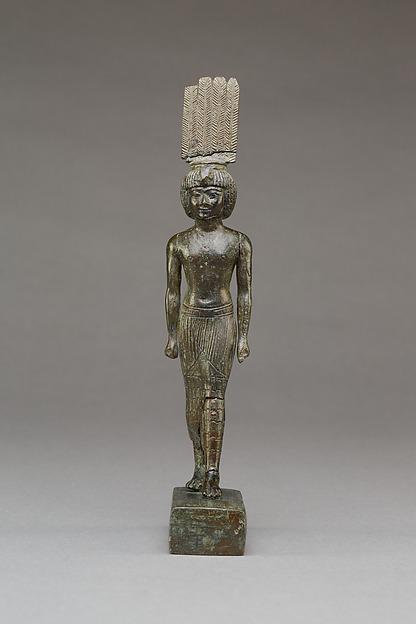
2017.7

Object Title
Onuris
Measurements
H. 17.5 × W. 3.4 × D. 6.4 cm (6 7/8 × 1 5/16 × 2 1/2 in.)
Creation Date
Third Intermediate Period, probably, 1070–664 BC
Credit Line
Purchase, Liana Weindling Gift, 2017
Culture
Country of Origin
Object Type
Materials / Techniques
Object URL
http://www.metmuseum.org/art/collection/search/736189
Provenance Information
Probably Collection of Countess Behague (d. 1939); thereafter by descent to Marquis de Ganay (Hubert, d. 1974, her nephew); consigned to Jean-Philippe Mariaud de Serres (d. 2007); purchased from Mariaud de Serres by W. Arnold Meijer, Netherlands, 1997; Collection of W. Arnold Meijer, 1997-2016; purchased by The Metropolitan Museum of Art, 2016
Exhibition Information
Allard Pierson Museum, Archaeological Museum of the University of Amsterdam, November 17, 2006, through March 25, 2007, and published in the catalog of that exhibition.
Publication Information
Objects for Eternity, Egyptian Antiquities from the W. Arnold Meijer Collecion, Carol A.R. Andrews and Jacobus van Dijk, Mainz 2006, No. 3.01 pp. 166-8 and 258.
Section of the AAMD Guidelines relied upon for the exception to 1970
Informed judgement that works were outside of the country of modern discovery before 1970
Explain why the object fits the exception set forth above
This work has provenance reported to the early 1900s, but the Museum has been unable to independently verify the documentation. The work was acquired by W. Arnold Meijer in 1997 and published and exhibited in 2006. This very beautiful figure represents the fascinating and important god Onuris in a way the Metropolitan Museum’s two other examples cannot. The statuette is a fine and elegant casting and presents stylistic and technological features that are associated with the earliest period of regular bronze production in Egypt.
Subscribe to The Metropolitan Museum of Art