Home

2010.561

Object Title
Pouch with Tassels
Measurements
L. 21 in., W. 7 in., D. 3 in.
Creation Date
AD 1-700
Credit Line
Neusteter Textile Collection: Gift of Mr. and Mrs. Morris A. Long
Culture
Country of Origin
Object Type
Materials / Techniques
Object URL
www.denverartmuseum.org
Provenance Information
In the collection of Mr. and Mrs. Morris A. Long of Colorado since the 1980's.
Exhibition Information
None known prior to DAM acquisition.
Publication Information
None known prior to DAM acquisition.
Section of the AAMD Guidelines relied upon for the exception to 1970
Cumulative facts and circumstances
Explain why the object fits the exception set forth above
The Denver Art Museum's encyclopedic pre-Columbian collection includes several dozen examples of Nasca ceramics, including early pieces with incised decorations, and later slip-painted specimens. Holdings of Nasca textiles are limited, however, making it difficult to provide the public with a complete picture of the Nasca artistic production. Andean textiles are regarded as one of the world's greatest weaving traditions. This unusually constructed bag, with typical Nasca coloration, will help the public appreciate the artistic and technical mastery of this tradition.

2011.358

Object Title
Tasseled Tunic
Measurements
H. 21 in., W. 53 in.
Creation Date
AD 900-1400
Credit Line
Gift in memory of Richard Levine
Culture
Country of Origin
Object Type
Materials / Techniques
Object URL
http://www.denverartmuseum.org
Provenance Information
Inherited by donor from Richard Levine in 2007; acquired by Levine from Steve Berger of San Francisco in 1992 or 1993.
Exhibition Information
The Andean Tunic, 400 BCE-1800CE. The Metropolitan Museum of Art, March 8-Sept. 18, 2011.
Publication Information
None known prior to DAM acquisition.
Section of the AAMD Guidelines relied upon for the exception to 1970
Cumulative facts and circumstances
Explain why the object fits the exception set forth above
The kings of Chimor ruled much of Peru's ancient north coast desert region. Nobles were entombed with precious metalwork, blackware ceramics, and lavishly decorated garments. This exceptionally well preserved garment has an openwork tapestry structure, decorated with numerous tassels. Constructed in a workshop setting by a team of skilled artisans, it reveals important information on Chimu weaving techniques and production methods. Its acquisition by the Denver Art Museum allows the public to understand the great value attached to textiles by ancient Andean peoples, and the technical and artistic mastery they achieved. It also makes this work available to scholars for research.

2009.56

Object Title
Group of narrow bands, tied at intervals
Measurements
Length: 288 in. (7 m. 31.521 cm.); Width (widest bands); 3/16 in. (.476 cm.)
Creation Date
c. 1476-1534, or earlier
Credit Line
Gift of Myrtie Rawlins Rice and Martha Sue Rawlins
Culture
Country of Origin
Object Type
Materials / Techniques
Object URL
http://www.dm-art.org/
Provenance Information
Previously with the family of Roderick A. Rawlins; thence given to Dallas Museum of Art (accession date: December 23, 2009).

Exhibition Information
N/A
Publication Information
N/A
Section of the AAMD Guidelines relied upon for the exception to 1970
Informed judgement that works were outside of the country of modern discovery before 1970
Explain why the object fits the exception set forth above
Although provenance is alleged to at least 1960, the DMA has been unable to substantiate the precise date of its departure from its probable country of origin because a previous owner is deceased. The Rawlins family lived in southern Peru during the 1950s, when they acquired objects representing ancient south coast Peruvian cultures such as Nasca and Ica. According to Myrtie R. Rice (phone conversation with Carol Robbins/DMA, 2/1/2012), her parents acquired the textile during the 1950s. Mrs. Rawlins (her mother) died in Peru in 1960, after which the family returned to Dallas. The textile is unusual, but it offers greater potential for study than for exhibition. The extensive shedding of fibers from the individual bands suggests that the textile may date from Middle Horizon or earlier rather than the Late Horizon, as it was conservatively catalogued originally.

2011.111.1-.2

Object Title
Sleeved Tunic and Tasseled Band
Measurements
Tunic: 22 ½ inches x 59 ½ inches. Band: 2 inches x 117 ¾ inches
Creation Date
1100 to 1532 A.D.
Credit Line
Severance and Greta Millikin Purchase Fund
Country of Origin
Object Type
Materials / Techniques
Object URL
http://goo.gl/I0W9x
Provenance Information
Nathaniel W. Hicks and Carmen Z. Hicks, late 1950s or early 1960s to 1972; Carmen Z. Hicks, 1972 to 1995; William Hicks, 1995 to 2011.

PUBLICATION HISTORY: None.

Exhibition Information
None
Publication Information
None
Section of the AAMD Guidelines relied upon for the exception to 1970
Informed judgement that works were outside of the country of modern discovery before 1970
Explain why the object fits the exception set forth above
In addition to the ownership history provided by the seller, the late Carmen Z. Hicks stated in a 1991 letter written in connection with a loan of the objects that her husband, the late Nathaniel W. Hicks, acquired and brought the textiles to the U.S. by 1963. This statement is consistent with the provenance of similar textiles. Where collection dates can be determined, all other Chimú white cotton garments in the same style (the so-called Pelican Style) entered public or private institutions (principally in the United States) before 1970.
The tunic is a relatively rare type and fills a significant gap in the Chimú holdings of the Cleveland Museum of Art, where it will join a set of white Pelican Style garments that consists of a mantle (or hanging), a loincloth, a padded hat, a turban, and a tasseled band.

57.2308

Object Title
Headband
Measurements
W: 1 5/8 x L: 16 3/8 in. (4.1 x 41.6 cm)
Creation Date
1100-1550
Credit Line
Private Collection, New York, 2009
Country of Origin
Object Type
Materials / Techniques
Object URL
http://art.thewalters.org/viewwoa.aspx?id=79425
Provenance Information
New World Antiquities, San Francisco [date and mode of acquisition unknown]; Private collection, 1988, by purchase; Walters Art Museum, 2009, by gift.
Exhibition Information
No known exhibitions.
Publication Information
No known publications.
Section of the AAMD Guidelines relied upon for the exception to 1970
Gift or bequest expected or on loan prior to 2008
Explain why the object fits the exception set forth above
Communications between the Walters Art Museum and the donor of this gift began in November 2005.

50.3586, 50.3587, 51.2804, 52.262

Creator
Barberini Manufactory, Rome
Object Title
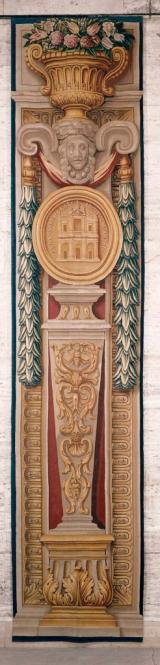
Four pillar tapestries (from the series THE LIFE OF POPE URBAN VIII)
Measurements
Each about 222 x 48 inches
Credit Line
Gift of Eugene L. Garbáty in memory of his parents, Josef and Rosa Garbáty and Charles Potter Kling Fund
Creation Date
1663-1679
Object Type
Object URL
http://www.mfa.org/collections/object/four-pillar-tapestries-from-the-series-the-life-of-pope-urban-viii-553213

Claim Resolution

Resolution
Agreement reached, museum retained work
Resolution Date
March, 2011
Details of Resolution
In March, 2011, the Museum of Fine Arts, Boston finalized a settlement with the heirs of Jakob and Rosa Oppenheimer, allowing the museum to retain four seventeenth-century tapestries, which were included in a forced sale in Berlin in 1935.

The four tapestries were part of a larger series that depicted the life and achievements of Pope Urban VIII. By 1928, eight tapestries from the series, including the four at the MFA, were owned by the art dealer Margraf in Berlin. Margraf was run by Jakob Oppenheimer and his wife Rosa, who were Jewish. In 1933, the Oppenheimers fled Germany to avoid Nazi persecution and relocated to France. During their absence they were forced out of their management roles at Margraf and were forbidden from performing any legal transactions for the company.

As a well-known Jewish business, Margraf was extinguished as quickly as possible by the Nazi regime. The gallery stock was sold off rapidly in a series of auctions held in Berlin in 1935. The Oppenheimers were unable to realize the proceeds from these sales. Recent research confirmed that the four MFA tapestries were sold to an unknown buyer at one of the 1935 auctions. The MFA contacted the Oppenheimer heirs in 2010 to inform them of their location at the MFA, and to begin settlement discussions.

The tapestries have been at the MFA since the 1950s, and were gifts from Eugene Garbáty, a German Jewish art collector. Garbáty purchased six of the eight tapestries from an unknown dealer shortly after they sold at auction in 1935. He was told that they had come out of a castle in Austria, and was unaware that they had belonged to Margraf or been in a forced sale. Garbáty, himself a victim of Nazi persecution, brought four of the tapestries with him when he fled Germany for the United States in 1939; he gave them to the MFA between 1950 and 1952.

46.1198

Creator
Bohemian workshop
Object Title
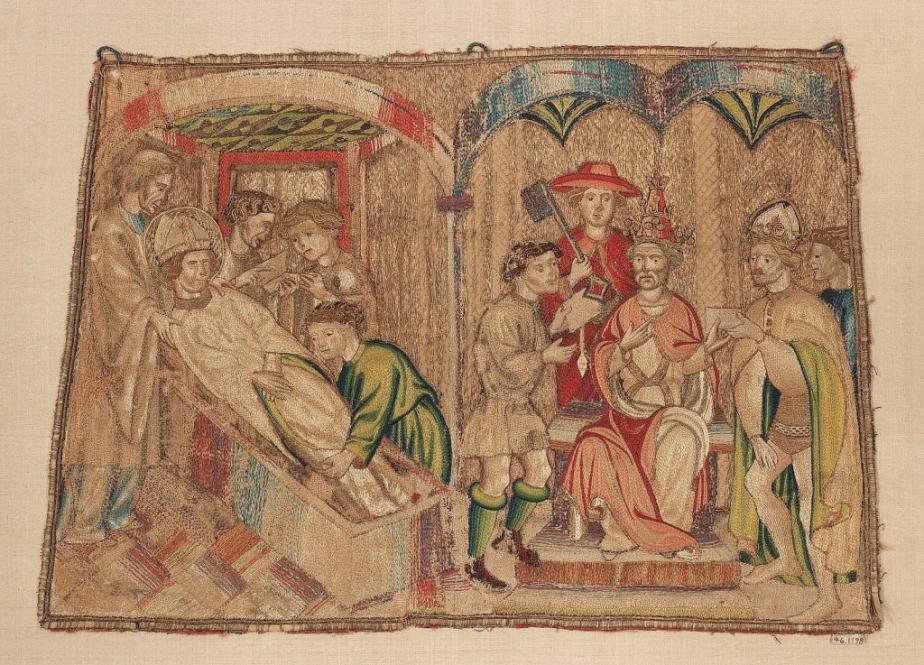
Entombment of Saint Vigilius
Measurements
35 x 49.3 cm (13 3/4 x 19 7/16 in.)
Credit Line
Otis Norcross Fund
Creation Date
About 1390-1391
Object Type
Object URL
http://www.mfa.org/collections/object/embroidered-panel-49020

Claim Resolution

Resolution
Work restituted to heirs or other representatives
Resolution Date
2010
Details of Resolution
In the fall of 2010, the MFA returned to the Museo Diocesano Tridentino (Diocesan Museum of Trent, Italy) an embroidered panel, the Entombment of Saint Vigilius, dating from around 1390–1391. The embroidery depicts the burial of Saint Vigilius (b. about 353–d. 405), the third bishop and patron saint of Trent, and the delivery of the news of his martyrdom to the pope and Emperor Theodosius.

The narrative cycle of the life of the saint was depicted on a number of embroidered panels, which were originally sewn onto the consecration vestments of George of Liechtenstein, appointed bishop prince of Trent in 1390. In the early 20th century, the five embroideries that remained from the original cycle were housed in the Museo Diocesano Tridentino. The museum’s original location in the Theological Seminary was subsequently closed, and the embroideries were placed in the cathedral sacristy. There, presumably between 1939 and 1944, all trace was lost of the panel showing the burial of Vigilius and the announcement of his death. The MFA purchased the embroidery in 1946 from an Italian art dealer in New York without knowledge of its subject matter or provenance. Prior to the acquisition, curatorial staff inquired about its history and were told only that its previous owner had inherited it along with a large collection of other antique objects. The Museum had no additional information about its provenance until 2008, when Dr. Evelin Wetter of the Abegg-Stiftung (Riggisberg, Switzerland) contacted the MFA, indicating that the panel was once part of the Saint Vigilius series from the Museo Diocesano Tridentino. Curatorial research by the MFA confirmed that the embroidery belonged to that series. In June 2008, the MFA contacted the Museo Diocesano to initiate discussions about its return, which concluded in April 2010 with the signing of an agreement by the MFA, the Archdiocese of Trent, and the Museo Diocesano.
Subscribe to Textiles