Home

2011.029

Object Title
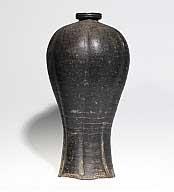
Maebyong vase
Measurements
h: 16 in. (40.6 cm)
Creation Date
12th or 13th century
Credit Line
Acquired through the George and Mary Rockwell Fund
Culture
Country of Origin
Object Type
Materials / Techniques
Object URL
http://emuseum.cornell.edu/objects/viewcollections
Provenance Information
n.d.-1968 collection of Mr. Jeong Jong-hwan, Busan, South Korea; 1968-1990 collection of Mrs. Mia Jo, Los Angeles, CA (gift of her father, Mr. Jeong Jong-hwan); 1990-2011 collection of Mrs. Keum Ja and Mr. Peter Kang, New York (purchased from Mrs. Jo); 2011 collection of Herbert F. Johnson Museum of Art, Cornell University, Ithaca (purchased from Mr. and Mrs. Kang through Kang Collection)
Exhibition Information
None
Publication Information
None
Section of the AAMD Guidelines relied upon for the exception to 1970
Cumulative facts and circumstances
Explain why the object fits the exception set forth above
The object was sent, as part of a larger gift, from its country of origin to the United States in 1968. It has remained in the United States since then, as per correspondence on file.

2015.22

Object Title
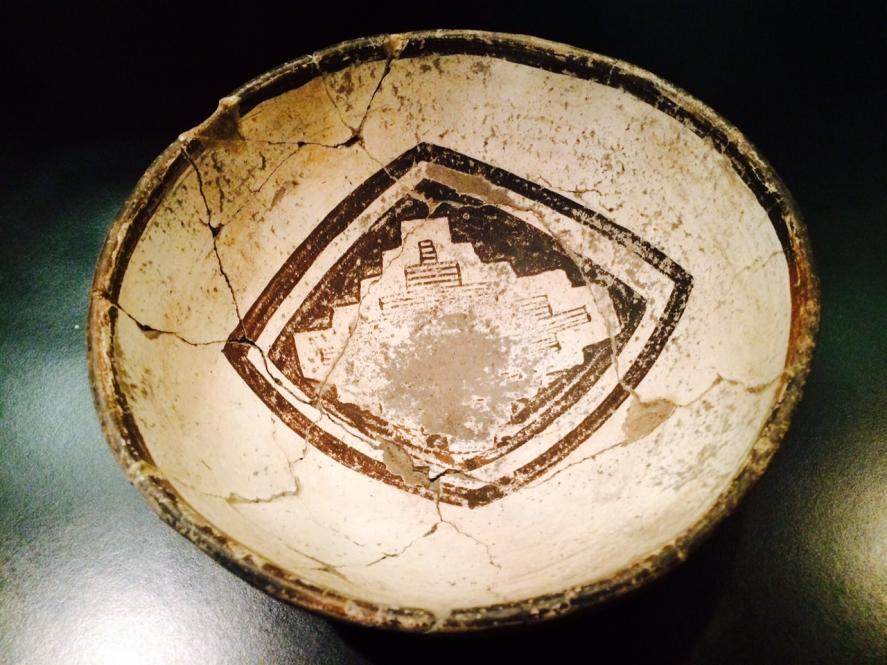
Mimbres Bowl
Measurements
3 5/8" high x 7 7/8" diameter
Creation Date
12th century
Credit Line
Gift of Charlene Wilkens Hursh
Culture
Country of Origin
Object Type
Materials / Techniques
Museum's Definition of Antiquity
earlier than 1492
Provenance Information
Said to have been found on private land; Robert Nichols Gallery, Santa Fe, NM; purchased from them by Charlene Wilkens Hursh, late 1980s; her gift to the Gallery in 2015
Exhibition Information
None known
Publication Information
None known
Section of the AAMD Guidelines relied upon for the exception to 1970
Cumulative facts and circumstances
Explain why the object fits the exception set forth above
Object is within its country of creation. Consultated with Zuni elder who believed this would not fall under NAGPRA consideration.

2015.306

Object Title
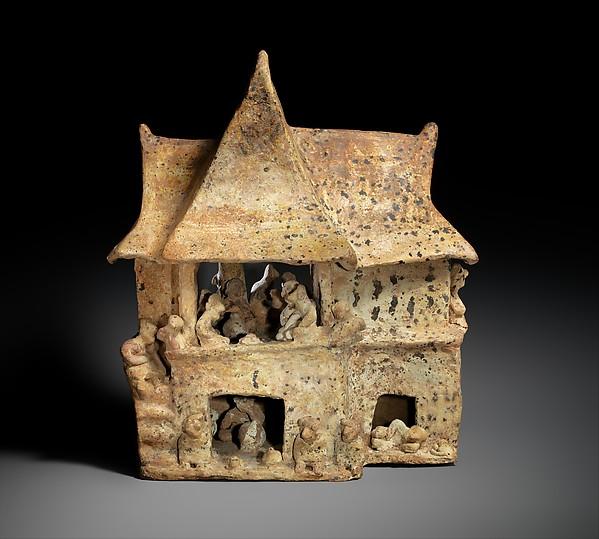
House Model
Measurements
H. 12 X W. 10 1/4 x D. 6 3/4 in. (30.5 x 26 x 17.1 cm)
Creation Date
100 B.C.–A.D. 200
Credit Line
Gift of Joanne P. Pearson, in memory of Andrall E. Pearson, 2015
Culture
Country of Origin
Object Type
Materials / Techniques
Object URL
http://www.metmuseum.org/collection/the-collection-online/search/319227
Provenance Information
Collection of Allan L. Long, New York, by 2000; Acquired by Ancient Art of the New World, New York, from Allan L. Long in 2000; Purchased from Ancient Art of the New World, New York, by Andrall E. and Joanne P. Pearson in September 2002; Collection of Andrall E. and Joanne P. Pearson, New York, 2002 to 2015; accepted as a promised gift from Mr. and Mrs. Pearson to The Metropolitan Museum of Art in 2004; given by Mr. and Mrs. Pearson to The Metropolitan Museum of Art in 2015.
Exhibition Information
This object was displayed at the Metropolitan Museum from October 19, 2004 through April 3, 2005 as part of the exhibition Heritage of Power: Ancient Sculpture from West Mexico. The Andrall E. Pearson Family Collection.
Publication Information
Kristi Butterwick, Heritage of Power: Ancient Sculpture from West Mexico. The Andrall E. Pearson Family Collection, New York, The Metropolitan Museum of Art/Yale University Press, 2004: 76-78.

Sarro, Patricia Joan, and James Doyle. "Monumental Imaginings in Mesoamerican Architectural Models." In Design for Eternity: Architectural Models from the Ancient Americas, edited by Joanne Pillsbury. New York: The Metropolitan Museum of Art, 2015, pp. 30–31, 38–39, figs. 27, 38, 39.
Section of the AAMD Guidelines relied upon for the exception to 1970
Gift or bequest expected or on loan prior to 2008
Explain why the object fits the exception set forth above
The work was accepted as a promised gift to The Metropolitan Museum of Art in 2004. The work was exhibited at the Metropolitan Museum from October 19, 2004 through April 3, 2005. This architecturally complex, ceramic structure features a feast for the dead with many intricate details. This model provides a rare opportunity to see architectural details that have not survived to the present day, such as plastered and painted thatched roofs. More importantly, the model depicts aspects of ritual and community life as ancient Nayarit artists conceived them. As such this work conveys a sense of place and activity in a way that few other objects do, an especially crucial feature for works of art from a region without contemporary texts.

2015.226a,b

Object Title
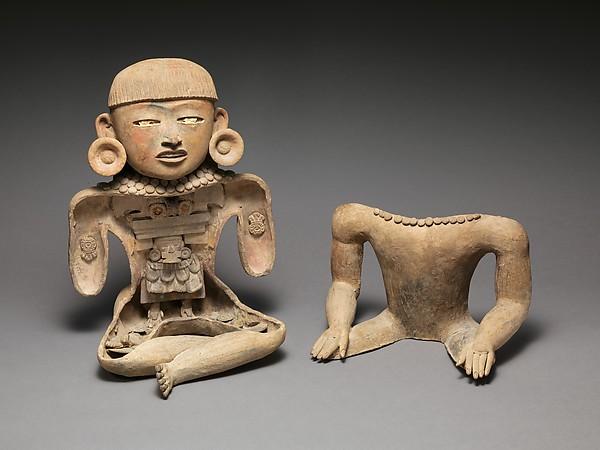
Teotihuacan-Style Hollow Figurine with Removable Chest Plate
Measurements
H. 14 3/4 x W. 10 5/8 in. (37.5 x 27 cm)
Creation Date
5th–7th century
Credit Line
Partial and Promised Gift of Linda M. Lindenbaum, from the Collection of Samuel H. and Linda M. Lindenbaum, 2015
Country of Origin
Object Type
Materials / Techniques
Object URL
http://www.metmuseum.org/collection/the-collection-online/search/684338
Provenance Information
Eduardo Paredes, Guatemala City, before July 1973; Edward H. Merrin Gallery, New York, until 1974; Mr. and Mrs. Samuel H. Lindenbaum, New York, partial gift, 1974–2015
Exhibition Information
Teotihuacan, Art from the City of the Gods [M.H. de Young Memorial Museum, San Francisco, 26 May – 31 October 1993], Cat. No. 66, pp. 214-215.
Publication Information
Hellmuth, Nicholas M. 1975. The Escuintla Hoards: Teotihuacan Art in Guatemala. F.L.A.A.R. Progress Reports vol. 1 no. 2, Plate 42A-B, p. 58. Photographs by Edwin Shook; Architectural Digest June 1981 (cover); Berjonneau, Gerald et al. Rediscovered Masterpieces of Mesoamerica. 1985. New York, Editions Arts. Photographs by Justin Kerr. Cat. No. 153, p. 118; Berrin, Kathleen, and Esther Pasztory, editors. 1993. Teotihuacan: Art from the City of the Gods. New York, Thames and Hudson. Cat. No. 66, pp. 214-215, 1994.
Section of the AAMD Guidelines relied upon for the exception to 1970
Cumulative facts and circumstances
Explain why the object fits the exception set forth above
This object was first photographed in 1973, first published in 1975 and featured in four subsequent publications, and was exhibited in 1993. This figurine comes from the Pacific Coast region of Guatemala, from which the Museum only has one other object. This style of “hollow” or “host” figurines found in Guatemala is indicative of the long-distance influence of the great Mexican city of Teotihuacan, the largest in the Precolumbian Americas. This successful and long-lasting center of merchants, artists, and others later became a site of pilgrimage for the Aztecs. These rare “host figures” were collected by artists such as Diego Rivera, and are considered among the most evocative images in Teotihuacan art. The proposed example is one of the largest and finest known.

2014.632.1

Object Title
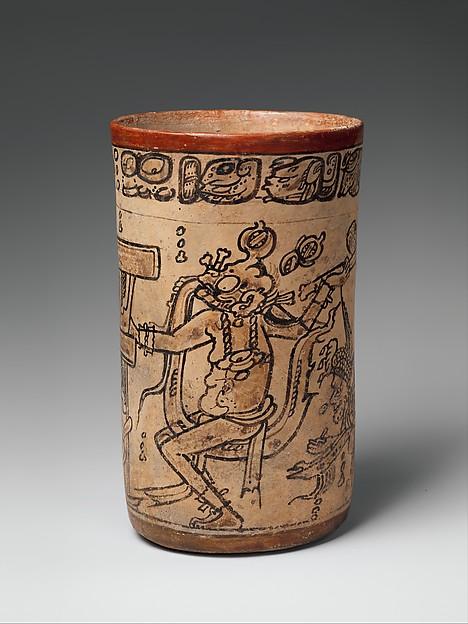
Codex-Style Vase with Mythological Scene
Measurements
H. 7 1/2 × Diam. 4 7/16 × Circum. 13 7/16 in. (19 × 11.2 × 34.2 cm)
Creation Date
ca. 7th or 8th century
Credit Line
Gift of Justin Kerr in memory of Barbara Kerr, 2014
Culture
Country of Origin
Object Type
Materials / Techniques
Object URL
http://www.metmuseum.org/collection/the-collection-online/search/662967?rpp=30&pg=1&ft=kerr&pos=1
Provenance Information
[Spencer Throckmorton, New York, until 1984]; Justin and Barbara Kerr, New York, 1984–2014; given to The Metropolitan Museum of Art by Justin and Barbara Kerr in 2014.
Exhibition Information
The work was on loan to, and on display at, The Metropolitan Museum of Art from 1994 until 2004.
Publication Information
Kerr, Justin, The Maya Vase Book: Volume 2. New York, Kerr Associates. p. 211 (1990); Grube, Nikolai, and Werner Nahm, A Census of Xibalba: A Complete Inventory of Way Characters on Maya Ceramics, included in The Maya Vase Book Vol.4, eds. Barbara Kerr and Justin Kerr, pp. 686-715. New York, Kerr, Associates. New York. p. 688 (1994); Coe, Michael, and Justin Kerr, The Art of the Maya Scribe. New York, Harry N. Abrams. p. 156-157; Fig. 127 (1998); Knowlton, Timothy, The Stone-in-Hand Glyph (1999); Mora-Marin, David, The Structure of the Dedicatory Formula in Classic Lowland Mayan Texts: A Preliminary Typology, p. 28 (1999); Carrasco, Michael David, and Kerry Hull, The Cosmogonic Symbolism of the Corbeled Vault in Maya Architecture. Mexicon XXIV: 26-32. p. 27; Fig. 5 (2002); Zender, Marc, Glyphs for “Handspan” and “Strike” in Classic Maya Ballgame Texts. The PARI Journal 4(4):1-9. Fig 6, p. 5 (2004); Carrasco, Michael David, The Mask Flange Iconographic Complex: The Art, Ritual, and History of a Maya Sacred Image. Unpublished Ph.D. Dissertation. Department of Art History, University of Texas at Austin. p. 456; Fig. B.7 (2005); Boot, Erik What Happened on the Date 7 Manik’ 5 Who? An Analysis of Text and Image on Kerr Nos. 0717, 7447, and 8457. Wayeb Notes 21. p. 3 (2006); Houston, Stephen, David Stuart, and Karl Taube, The Memory of Bones: Body, Being, and Experience among the Classic Maya. Austin, University of Texas Press. p. 49 Fig. 1.52 (a) (2006); Bassie-Sweet, Karen, Maya Sacred Geography and the Creator Deities. Norman, University of Oklahoma Press. p. 146-147 (2008); Schoenmakers, Paul, Drawing, After Rollout of Vase Ker 2068. Wayeb Drawing Archive (2008); Braakhuis, H.E.M., The Tonsured Maize God and Chicome-Xochitl as Maize Bringers and Culture Heroes: A Gulf Coast Perspective. Wayeb Notes No. 32, Fig. 5 (2009).
Section of the AAMD Guidelines relied upon for the exception to 1970
Cumulative facts and circumstances
Explain why the object fits the exception set forth above
The work has provenance to 1983. The work has been published several times in academic journals and books, first in 1990 and including in the recent volume by three of the leading scholars in the field, entitled Memory of Bones (2006). The work has been published on the website Mayavase.com since January 1999 (acc. No. 2068), a site created by the donors and developed in concert with the Foundation for the Advancement in Mesoamerican Studies, Inc. The work was on loan to The Metropolitan Museum of Art for display from 1994 through 2004. This work is a spectacular example of a “codex-style” vessel showing a mythological creation scene. These rare vessels are among the few testaments to the superb calligraphic style of Maya artists and scribes. This vessel of exceptional quality will significantly enhance the Metropolitan Museum’s limited collection of Maya ceramics.

2014.043

Object Title
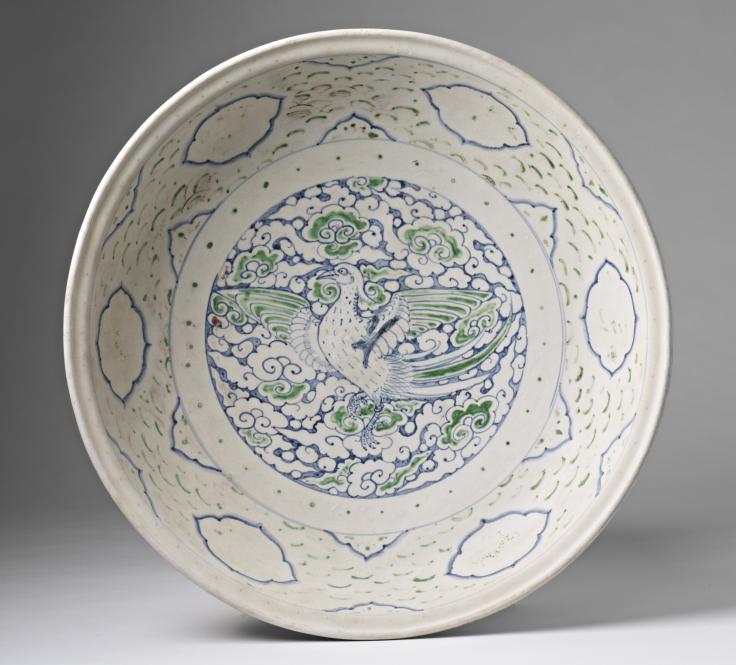
Large polychrome charger with bird
Measurements
Dia. 17 1/2 in. (44.5 cm)
Creation Date
15th or 16th century
Credit Line
Acquired through the George and Mary Rockwell Fund
Culture
Country of Origin
Materials / Techniques
Provenance Information
between 1966/1970 - until early 1990s collection of Ken (J.J.) Baars (1924-2010), Surrey, United Kingdom; early 1990s - 2014 private collection, Boston, MA (purchased from Baars); (2014 with Zetterquist Galleries, New York (on consignment from private Boston collector); 2014 collection of Herbert F. Johnson Museum of Art, Cornell University, Ithaca, NY (purchased through Zetterquist Galleries)
Exhibition Information
Zetterquist Galleries, New York, September 2014
Publication Information
n/a
Section of the AAMD Guidelines relied upon for the exception to 1970
Cumulative facts and circumstances
Explain why the object fits the exception set forth above
It is an exceptional example of Vietnamese export ware that was widely distributed in Southeast Asia. It was collected between 1966-1970, when Mr. Baars was stationed in Indonesia as a geophysicist with Royal Dutch Shell until 1970, when he returned to the Netherlands along with his collection of Southeast Asian ceramics. This object also demonstrates the importance of this medium and form in the Vietnamese culture, particularly when held in dialogue with similar objects from other dynasties and/or cultures.

2014.042a,b

Object Title
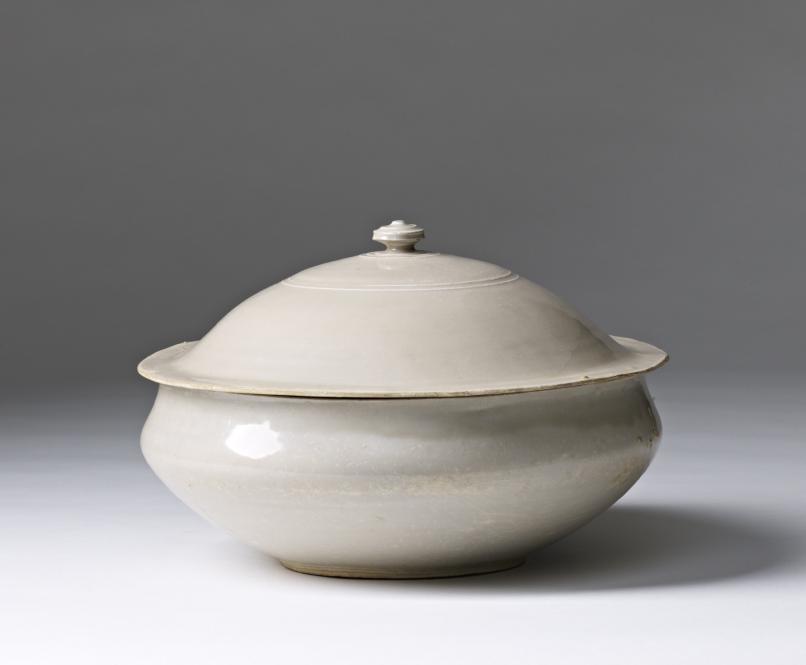
Large white-ware lidded bowl
Measurements
Dia. 7 3/4 in. (19.7 cm)
Creation Date
Le Dynasty (1428-1788)
Credit Line
Acquired through the Lee C. Lee Fund for East Asian Art
Country of Origin
Materials / Techniques
Provenance Information
n.d.-2014 private collection, Japan; (2014 with private dealer, Japan (possibly on consignment from private collector)); (2014 with Zetterquist Galleries, New York (on consignment from private Japanese dealer)); 2014 collection of Herbert F. Johnson Museum of Art, Cornell University, Ithaca, NY (purchased through Zetterquist Galleries)
Exhibition Information
n/a
Publication Information
n/a
Section of the AAMD Guidelines relied upon for the exception to 1970
Cumulative facts and circumstances
Explain why the object fits the exception set forth above
It is not clear that this object was ever in an archaeological context, and is the type of object that could have been exported to Japan early on.

Further, there are only a few pieces of this period and style represented in our collection, and significant examples of this specific form of white-ware are rare. It is an exceptional object and demonstrates the importance of this medium and form in the Vietnamese culture, particularly when held in dialogue with similar objects from other dynasties and/or cultures.

2014.007

Object Title
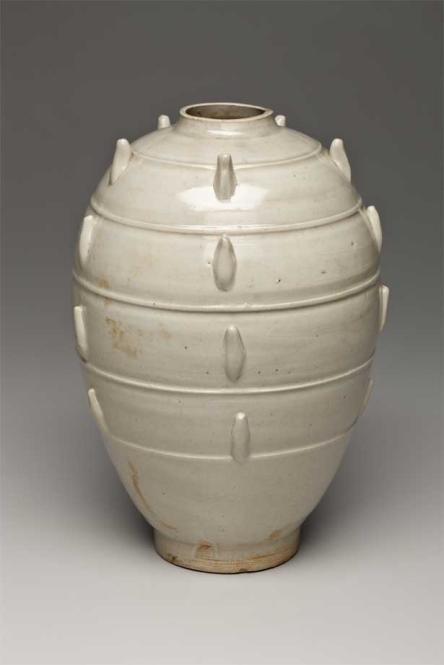
Large Yue-type southern celadon jar with "horns"
Measurements
H. 12 5/16 in. (31.3 cm)
Creation Date
Song dynasty (960-1279)
Credit Line
Acquired through the generosity of Judith Stoikov, Class of 1963
Culture
Country of Origin
Materials / Techniques
Object URL
n/a
Museum's Definition of Antiquity
Tang dynasty (618-906 AD) or earlier
Provenance Information
1930s-1959 collection of A.W. Bahr (1877-1959), Ridgefield, CT; 1959 estate of A.W. Bahr; 1959-early 1980s collection of Edna H. Bahr (d. 1986), Ridgefield, CT (by descent from her father A.W. Bahr); early 1980s-2014 collection of Robert Hatfield Ellsworth (1929-2014), New York (purchased from Edna H. Bahr); (2014 with Zetterquist Galleries, New York (on consignment from Ellsworth); 2014 collection of Herbert F. Johnson Museum of Art, Cornell University, Ithaca, NY (purchased through Zetterquist Galleries)
Exhibition Information
Zetterquist Galleries, New York, NY, Chinese Monochromes, March 15 - March 22, 2014
Publication Information
Zetterquist, Eric. Chinese Monochromes [an exh. cat.]. (New York: Zetterquist Galleries, 2014).
Section of the AAMD Guidelines relied upon for the exception to 1970
Cumulative facts and circumstances
Explain why the object fits the exception set forth above
Object was in the collection of Abel W. Bahr (1877-1959) before 1970, as per documentation, on file.

2013.024.002

Object Title
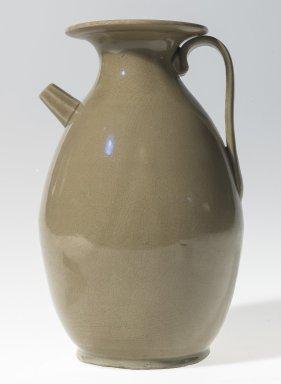
Yue-yao ewer
Measurements
H. 22 cm (8 11/16 in.)
Creation Date
Tang dynasty (618-906 AD)
Credit Line
Acquired through the George and Mary Rockwell Fund
Culture
Country of Origin
Materials / Techniques
Object URL
http://library24.library.cornell.edu:8280/luna/servlet/s/a3g8hr
Museum's Definition of Antiquity
Tang dynasty (618-906 AD) or earlier
Provenance Information
n.d.-2008 collection of private dealer, Hong Kong; 2008 collection of Zetterquist Galleries, New York (purchased from private dealer, Hong Kong); 2008-2012 collection of Akiko Yamazaki, Los Altos Hills, CA (purchased from Zetterquist Galleries); (2012 with Zetterquist Galleries (on consignment from Akiko Yamazaki)); 2012 collection of Lingao Tong, Ann Arbor and Ningbo China (purchased from Yamazaki through Zetterquist Galleries); 2012-2013 collection of Zetterquist Galleries, New York (acquired in trade from Lingao Tong); 2013 Herbert F. Johnson Museum of Art, Cornell University, Ithaca (purchased from Zetterquist Galleries)
Exhibition Information
Zetterquist Galleries, New York, 2008
Publication Information
n/a
Section of the AAMD Guidelines relied upon for the exception to 1970
Cumulative facts and circumstances
Explain why the object fits the exception set forth above
In 2012, a previous owner had this object with him in China, and had received official permission to export it out of the country. The wax export seal is affixed to the bottom of the object.

2013.024.001

Object Title
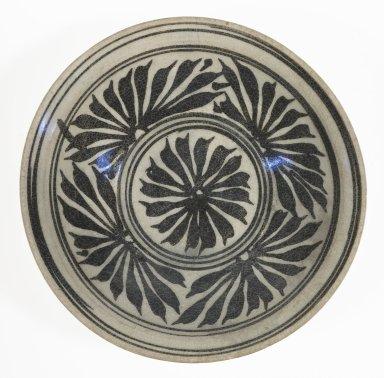
Kalong plate with floral decoration
Measurements
Dia. 21.8 cm (8 9/16 in.)
Creation Date
15th-16th century
Credit Line
Acquired through the George and Mary Rockwell Fund
Country of Origin
Materials / Techniques
Object URL
http://library24.library.cornell.edu:8280/luna/servlet/s/8rjyf9
Provenance Information
n.d.-by 2013 collection of Hiromu Honda, Japan; (by 2013 with Noriki Shimazu, Osaka (on consignment from Honda collection)); 2013 collection of Zetterquist Galleries, New York (purchased through Noriki Shimazu); 2013 Herbert F. Johnson Museum of Art, Cornell University, Ithaca (purchased from Zetterquist Galleries)
Exhibition Information
n/a
Publication Information
n/a
Section of the AAMD Guidelines relied upon for the exception to 1970
Cumulative facts and circumstances
Explain why the object fits the exception set forth above
It is not clear that this object was ever in an archaeological context, and it is the type of object that may have been exported to Japan early on.
Subscribe to Ceramic