Home

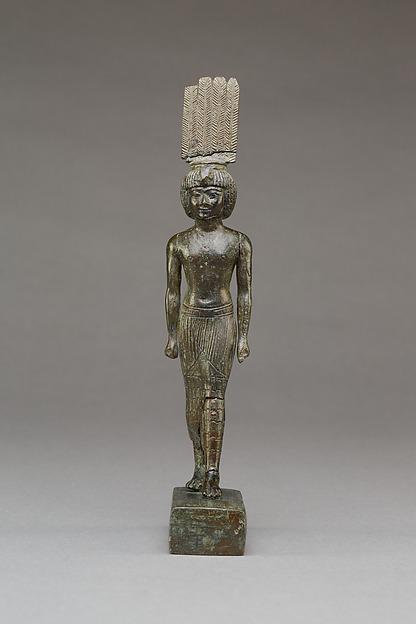
2018.52

Object Title
King Shabaka?
Measurements
7 × 3 1/4 × 4 1/2 in. (17.8 × 8.3 × 11.4 cm)
Creation Date
ca. 716-702 B.C.E.
Credit Line
Gift of Edna R. Russmann
Museum Name
Museum Contact
meghan.bill@brooklynmuseum.org
Culture
Country of Origin
Object Type
Materials / Techniques
Object URL
https://www.brooklynmuseum.org/opencollection/objects/223684
Museum's Definition of Antiquity
Ancient Egypt (Muslim conquest of Egypt, 642 C.E.)
Provenance Information
Archaeological provenance not yet documented; before December 2, 1988, acquired by an unidentified California dealer; December 2, 1988, offered for sale by Sotheby's, New York, NY, "Antiquities and Islamic Art," lot 143; by July 1998, acquired by Edna R. Russmann of Brooklyn, NY; 2018, gift of Edna R. Russmann to the Brooklyn Museum.
Exhibition Information
Pulitzer Arts Foundation, "The Shattered Beauty of Egyptian Art," March 22, 2019-September 24, 2019.
No earlier exhibition history.
Publication Information
Sotheby’s, New York, "Antiquities and Islamic Art," December 2, 1988, lot 143.
Section of the AAMD Guidelines relied upon for the exception to 1970
Cumulative facts and circumstances
Explain why the object fits the exception set forth above
This object has a known provenance dating to at least 1988. Creditable reports place this object in an old California collection but lack written documentation.

2018.913.4

Object Title
Bone plaque with Female Dancer
Measurements
6 5/8 × 1 11/16 × 13/16 in. (16.8 × 4.3 × 2 cm)
Creation Date
4th–6th century
Credit Line
Gift of Dr. Marilyn Jenkins-Madina in loving memory of her husband, professor Maan Z. Madina, 2018
Culture
Country of Origin
Object Type
Materials / Techniques
Object URL
https://www.metmuseum.org/search-results#!/search?q=2018.913.4
Provenance Information
Charles Dikran Kelekian (d. 1982), New York; by descent to Nanette Kelekian, New York (sold 1986); [Sotheby’s, New York, May 1986 (sale no. 5464), lot no. 223/7]; sold to Ma’n Z. Madina and Marilyn Jenkins-Madina, New York (1986–2018); gift from Marilyn Jenkins-Madina to The Metropolitan Museum of Art, 2018.
Exhibition Information
None.
Publication Information
Sotheby’s, New York, May 1986 (sale no. 5464), lot no. 223/7.
Section of the AAMD Guidelines relied upon for the exception to 1970
Cumulative facts and circumstances
Explain why the object fits the exception set forth above
This work was in the collection of the dealer Charles Dikran Kelekian (active 1919-1982). This work was published in 1986 when it was sold by his daughter, Nanette Kelekian, at auction at Sotheby’s New York to Maan Z. Madina and Lyn Jenkins-Madina. The work has been in the New York collection of the Madinas for over 30 years. The Maenad is a rare late antique example of a female mythological figure on bone. An adaption of work attributed to Kallimachos (ca. 410-400 B.C.E.), this iconographical Maenad type is an important aspect of the Dioyonsiac motif in late antiquity and fits with other plaques in the Museum’s collection.


2017.453

Object Title
Box with Metal Mounts
Measurements
H. 1 3/4 in. (4.4 cm) W. 5 1/2 in. (14 cm) D. 2 1/8 in. (5.4 cm)
Creation Date
13th century
Credit Line
Gift of Dr. Marilyn Jenkins-Madina, in loving memory of her husband, Professor Maan Z. Madina, 2017
Culture
Country of Origin
Object Type
Materials / Techniques
Object URL
https://www.metmuseum.org/art/collection/search/624945
Provenance Information
Hagop Kevorkian, New York (before d. 1962); Sotheby's, New York, November 1975, to Jenkins-Madina; Marilyn Jenkins-Madina, New York (1975–2017; gifted to MMA)
Exhibition Information
This work has been on loan to and on display at The Metropolitan Museum of Art in its Islamic Gallery 454 since 2013.
Publication Information
This work is unpublished.
Section of the AAMD Guidelines relied upon for the exception to 1970
Informed judgement that works were outside of the country of modern discovery before 1970
Explain why the object fits the exception set forth above
This work has confirmed provenance to 1975 when it was acquired by Marilyn Jenkins-Madina. This work was reportedly in the collection of Hagop Kevorkian by 1962, but the Metropolitan Museum has been unable to independently confirm that provenance. An oval label that says “Kevorkian Collection” is sitting loose in the work of art. This work has been on loan to and on display at The Metropolitan Museum of Art since 2013. This work will be the only glass box from Medieval Egypt in the Metropolitan Museum collection of Islamic Art. It is a rare example of the use of glass for such a container which would have held a precious substance such as musk, ambergris or some other aromatic material. Its 13th century date indicates the continuing production of glass at the end of the Fatimid Dynasty and beginning of the Ayyubid Dynasty in Egypt, one of the main glass-making centers of the Islamic world.

2018.657

Object Title
Monumental Head of a Foreigner
Measurements
H. 33 × W. 44 × D. 49.5 cm, 146.1 kg (13 × 17 5/16 × 19 1/2 in., 322 lb.)
Creation Date
ca. 1295–1070 B.C.
Credit Line
Gift of Lewis and Elaine Dubroff, in celebration of the Museum's 150th Anniversary, 2017
Culture
Country of Origin
Object Type
Materials / Techniques
Object URL
https://www.metmuseum.org/art/collection/search/767641
Provenance Information
By 1967, Collection of Vincent Diniacopolous, Montreal (supported by undated photograph in family archive); Diniacopolous family, Montreal, by descent, 1967-1999; their sale, Sotheby’s, June 6, 1999; purchased at Sotheby’s by Elaine and Lewis M. Dubroff; Collection of Elaine and Lewis M. Dubroff, 1999-2017; Gift of Elaine and Lewis M. Dubroff to The Metropolitan Museum of Art, 2017.
Exhibition Information
None.
Publication Information
Sotheby’s New York, June 5, 1999, p. 24 (no. 38), “A Monumental Limestone Head of a Vanquished Foreigner.”

Section of the AAMD Guidelines relied upon for the exception to 1970
Informed judgement that works were outside of the country of modern discovery before 1970
Explain why the object fits the exception set forth above
This work has provenance confirmed to 1999 when it was sold at auction by Sotheby’s as a work from a private North American collector. The Metropolitan Museum of Art has provenance information back to the early 1960s that is supported by circumstantial evidence. Vincent Diniacopolous (1886-1967) was a Canadian dealer, who was first established shops in Cairo, Paris, and Southern France in 1922 before moving to Montreal in 1951. An early photograph in the family’s archive, now in Concordia University in Canada, suggests that the piece was on the art market as early as 1910s or 1920s, when Diniacopolous was in Egypt. He stopped acquiring pieces already in the early 1960s, due to a serious health problem, and the collection remained in his family following his death in 1967. This imposing head is a collection-changing addition to the Museum’s holdings because it is an architectural element of monumental size from a Ramesside building. During the Ramesside Period (ca. 1295-1070 B.C.), Egypt’s kings concentrated on the construction of public structures and the control of their empire, and our collection does not appropriately reflect this important time.
 

2018.4

Object Title
Head of a God or King
Measurements
6 5/8 × 5 9/16 × 2 1/4 in., 3.5 lb. (16.8 × 14.1 × 5.7 cm, 1.59kg)
Creation Date
ca. 1938-1759 B.C.E
Credit Line
Gift of David Curzon
Museum Name
Museum Contact
meghan.bill@brooklynmuseum.org
Culture
Country of Origin
Object Type
Materials / Techniques
Object URL
https://www.brooklynmuseum.org/opencollection/objects/224448
Museum's Definition of Antiquity
Before 500 C.E.
Provenance Information
Archaeological provenance not yet documented; before 1984, acquired by Ernest Erickson of New York, NY; June 23, 1989, sold at Sotheby's, New York, NY "Antiquities and Islamic Art," lot 46A; between 1989 and 1996, provenance not yet documented; by May 1996, acquired by Gawain McKinley of London, United Kingdom; between 1996 and 2006, provenance not yet documented; April 27, 2006 sold at Bonham’s, London, "The Antiquities Sale," lot 61; by 2007, acquired by Richard Philp, London; 2007 purchased from Richard Philp by David Curzon; 2018, gift of David Curzon to the Brooklyn Museum.
Exhibition Information
No previous exhibition history. Pulitzer Arts Foundation, "The Shattered Beauty of Egyptian Art," March 22, 2019-September 24, 2019.
Publication Information
Edward Bleiberg, "Why are the Noses Broken?" in "Striking Power: Iconoclasm in Ancient Egypt" forthcoming Summer, 2019, Pulitzer Arts Foundation.
Section of the AAMD Guidelines relied upon for the exception to 1970
Informed judgement that works were outside of the country of modern discovery before 1970
Explain why the object fits the exception set forth above
It was in the Ernest Erickson Foundation by 1984. The collection had stopped expanding by this time.

2017.75.1-2

Object Title
Egyptian Wooden Clappers
Measurements
21.6 cm (8 1/2 in.)
Creation Date
1985 - 1295 BC
Credit Line
Marilyn M. Simpson Fund
Culture
Country of Origin
Materials / Techniques
Object URL
http://www.mfa.org/collections/object/egyptian-wooden-clappers-one-of-a-pair-645723
Provenance Information
November 8, 1975, sold by the Galerie Uraeus, Paris, to Antoine (or Anton) Groth, Zurich; by descent within the family; April 15, 2015, consigned anonymously by a member of the Groth family, Christie’s, London (sale 10372), lot 160, to Walter Gilbert, Cambridge, MA; 2017, sold by Walter Gilbert to the MFA. (Accession Date: March 1, 2017)
Exhibition Information
None known.
Publication Information
None known.
Section of the AAMD Guidelines relied upon for the exception to 1970
Cumulative facts and circumstances
Explain why the object fits the exception set forth above
These clappers were on the European market in 1975 (if not earlier), several years before Egypt’s law no. 117 went into effect in 1983. Although they cannot be traced all the way to 1970, clappers are common and relatively minor objects, making them difficult to trace. Further information from the Galerie Uraeus is not available.

2015.595

Object Title
Upper Part of a Hippo Goddess
Measurements
H. 16.5 cm (6 1/2 in.); W. 12.9 cm (5 1/16 in.); D. 11.5 cm (4 1/2 in.)
Creation Date
2649–2528 BC
Credit Line
Purchase, Mr. and Mrs. John A. Moran Gift, 2015
Culture
Country of Origin
Object Type
Materials / Techniques
Object URL
http://www.metmuseum.org/art/collection/search/694156
Provenance Information
Purchased from Lucien Viola of the Galerie l'Ibis, who acquired the piece with many others from the Egyptian antiquities inventory of Ernst Kofler. Kofler was a dealer, prinicpally of Egyptian art in the 1950's and 1960's, that Viola had known for many years in Cairo. Documentation dating to 1989 from Kofler states that he had owned for 20 years the group of antiquities, of which the hippo goddess was one, consigned to Viola for sale in 1987.
Exhibition Information
This work was exhibited in connection with the 2014 Brussels Ancient Art Fair
Publication Information
Christies London sale catalogue, April 12, 2000, lot 79, “A Rare Limestone Upper Part of a Statue of Taweret (Tueris).” The work was published (with photograph) in connection with the 2014 Brussels Ancient Art Fair. The work was also published as the signature image for the Galerie L’Ibis online catalog in 2014 and 2015.
Section of the AAMD Guidelines relied upon for the exception to 1970
Informed judgement that works were outside of the country of modern discovery before 1970
Explain why the object fits the exception set forth above
The Metropolitan Museum of Art has provenance information back to the early 1960s that is supported by circumstantial evidence. Ernst Kofler was a Swiss dealer who acquired works in Egypt through his friend, Maguid Sameda, in the 1950s and 1960s. After Mr. Sameda died in the late 1960s, Mr. Kofler stopped collecting Egyptian objects. In 1987, Lucien Viola met and later married Mr. Kofler’s granddaughter. Mr. Kofler transferred Egyptian objects, including this statuette, to Mr. Viola for sale during the late 1980’s. Mr. Kofler signed a certification dated February 25, 1983, declaring that all of the Egyptian reliefs and statues he gave to Mr. Viola for sale had been with Mr. Kofler “for over 20 years in Lausanne, Switzerland.” In 1987, this work was listed in a shipping invoice before its transfer from Mr. Kofler to Mr. Viola Currently this statue is understood to be the earliest known three dimensional representation of a composite deity, a concept that was quintessentially Egyptian for its pantheon. This rare statue depicts an early hippo goddess where human, hippopotamus, crocodile and feline characteristics are combined into a single deity.

2016.493

Object Title
Amuletic Aegis of Bastet or Sakhmet
Measurements
H. 2.5 x W. 2 cm (1 x 13/16 in.)
Creation Date
Third Intermediate Period, ca. 1070-664 B.C.
Credit Line
Gift of Peter Gottesman, in honor of Mauricette E. Gottesman and George H. Gottesman, 2016
Culture
Country of Origin
Object Type
Materials / Techniques
Object URL
http://www.metmuseum.org/art/collection/search/549191?sortBy=Relevance&ft=2016.493&offset=0&rpp=20&pos=1
Provenance Information
Collection of Peter Gottesman since at least 1994, when the work was brought to the Metropolitan Museum. Mr. Gottesman took the work back in 1995 and returned it to the Metropolitan Museum as a loan and promised gift in 1997. The amulet remained at the Museum since that time and entered the Museum’s collection as a gift of Mr. Gottesman in 2016.
Exhibition Information
The work has been on loan to and on display at The Metropolitan Museum of Art since 1997.
Publication Information
None.
Section of the AAMD Guidelines relied upon for the exception to 1970
Gift or bequest expected or on loan prior to 2008
Explain why the object fits the exception set forth above
The work has been on loan to the Metropolitan Museum as a promised gift since 1997. Precious metal examples of aegides are rare, and this work exhibits the cloisonné inlay technique restricted to items of high technical expertise.

2017.7

Object Title
Onuris
Measurements
H. 17.5 × W. 3.4 × D. 6.4 cm (6 7/8 × 1 5/16 × 2 1/2 in.)
Creation Date
Third Intermediate Period, probably, 1070–664 BC
Credit Line
Purchase, Liana Weindling Gift, 2017
Culture
Country of Origin
Object Type
Materials / Techniques
Object URL
http://www.metmuseum.org/art/collection/search/736189
Provenance Information
Probably Collection of Countess Behague (d. 1939); thereafter by descent to Marquis de Ganay (Hubert, d. 1974, her nephew); consigned to Jean-Philippe Mariaud de Serres (d. 2007); purchased from Mariaud de Serres by W. Arnold Meijer, Netherlands, 1997; Collection of W. Arnold Meijer, 1997-2016; purchased by The Metropolitan Museum of Art, 2016
Exhibition Information
Allard Pierson Museum, Archaeological Museum of the University of Amsterdam, November 17, 2006, through March 25, 2007, and published in the catalog of that exhibition.
Publication Information
Objects for Eternity, Egyptian Antiquities from the W. Arnold Meijer Collecion, Carol A.R. Andrews and Jacobus van Dijk, Mainz 2006, No. 3.01 pp. 166-8 and 258.
Section of the AAMD Guidelines relied upon for the exception to 1970
Informed judgement that works were outside of the country of modern discovery before 1970
Explain why the object fits the exception set forth above
This work has provenance reported to the early 1900s, but the Museum has been unable to independently verify the documentation. The work was acquired by W. Arnold Meijer in 1997 and published and exhibited in 2006. This very beautiful figure represents the fascinating and important god Onuris in a way the Metropolitan Museum’s two other examples cannot. The statuette is a fine and elegant casting and presents stylistic and technological features that are associated with the earliest period of regular bronze production in Egypt.

2016.121

Object Title
Relief from the Tomb of a Nobleman
Measurements
46.5 x 20.5 x 2.5 cm (18 5/16 x 8 1/16 x 1 in.)
Creation Date
2140–1991 B.C.
Credit Line
Gift of Davis and Carol Noble in honor of Rita E. Freed
Culture
Country of Origin
Object Type
Materials / Techniques
Object URL
http://www.mfa.org/collections/object/relief-from-the-tomb-of-a-nobleman-436510
Provenance Information
May 19-June 4, 1976, anonymous sale, Koller, Zurich, lot 2358, to a private collector, Switzerland; sold by this private collector to Oliver Forge, London; sold by Oliver Forge to Royal-Athena Galleries, New York, 2003, sold by Royal-Athena to Davis and Carol Noble, Marblehead, MA; 2004, promised gift of Davis and Carol Noble to the MFA; 2016, gift of Davis and Carol Noble to the MFA. (Accession Date: April 27, 2016)
Exhibition Information
None known.
Publication Information
None known.
Section of the AAMD Guidelines relied upon for the exception to 1970
Gift or bequest expected or on loan prior to 2008
Explain why the object fits the exception set forth above
This relief was accepted as a promised gift in 2004, before AAMD guidelines required a documented provenance to 1970. It was outside of Egypt before 1983, when Egypt's Law of the Protection of Antiquities went into effect.
Subscribe to Egyptian