Home

2008.1054

Object Title
Denarius with Head of Apollo, struck under C. Calpurnius Piso L. f. Frugi
Measurements
Diameter: 18mm.; weight: 3.97 gm.; die axis: 5
Creation Date
67 B.C.
Credit Line
Gift of Cornelius C. Vermeule III
Culture
Country of Origin
Object Type
Materials / Techniques
Object URL
http://www.mfa.org/collections/object/denarius-with-head-of-apollo-struck-under-c-calpurnius-piso-l-f-frugi-411368
Provenance Information
By 2003, Edward J. Waddell, Ltd., Frederick, MD; August, 2003, sold by Waddell to Cornelius C. Vermeule, III (b. 1925 – d. 2008), Cambridge, MA [see note 1]; 2008, gift of Vermeule to the MFA. (Accession Date: October 22, 2008)

NOTES:
[1] Lent by Cornelius Vermeule to the MFA from 2004 until 2008 (loan no. L-T 326.1.2004).
Exhibition Information
“Games for the Gods: The Greek Athlete and the Olympic Spirit,” Museum of Fine Arts, Boston, July 21 – November 28, 2004.
Publication Information
J. Herrmann and C. Kondoleon, Games For the Gods (exh. cat., MFA, Boston, 2004), pp. 112, 180, fig. 80.
Section of the AAMD Guidelines relied upon for the exception to 1970
Cumulative facts and circumstances
Explain why the object fits the exception set forth above
The date and circumstances of the coin’s discovery are not known, but a Roman Republican silver denarius of this type is most likely to have been found in Italy. Per the MFA’s 2006 agreement with the Italian Ministry of Culture, the Museum contacted Ministry representatives prior to acquiring the coin; the Ministry raised no objection to the acquisition.

2008.171

Object Title
Aureus with bust of Septimius Severus
Measurements
Diameter: 20 mm.; weight: 7.36 gm.; die axis: 6
Creation Date
A.D. 202
Credit Line
Theodora Wilbour Fund in memory of Zoë Wilbour
Culture
Country of Origin
Object Type
Materials / Techniques
Object URL
http://www.mfa.org/collections/object/aureus-with-bust-of-septimius-severus-514401
Provenance Information
1991, private collection, United States; May 15, 1991, anonymous sale (Auction 52, from “a distinguished American collection”), Bank Leu, A.G., Zurich, lot 223. April 2, 2008, anonymous sale (Auction 46), Numismatica Ars Classica, Zurich, lot 617, to Harlan J. Berk, Ltd., Chicago; 2008, sold by Berk to the MFA. (Accession Date: June 25, 2008)
Exhibition Information
None known.
Publication Information
None known.
Section of the AAMD Guidelines relied upon for the exception to 1970
Cumulative facts and circumstances
Explain why the object fits the exception set forth above
The date and circumstances of the coin’s discovery are not known. Gold coins of this type, while struck at Rome, circulated widely and have been found within the present-day borders of many countries. Per the MFA’s 2006 agreement with the Italian Ministry of Culture, the Museum contacted Ministry representatives prior to acquiring the coin; the Ministry raised no objection to the acquisition.

41.935

Creator
Eglon van der Neer (Dutch, 1634–1703)
Object Title
Portrait of a Man and Woman in an Interior
Measurements
73.9 x 67.6 cm (29 1/8 x 26 5/8 in.)
Credit Line
Seth K. Sweetser Fund
Creation Date
1665-1667
Object Type
Object URL
http://www.mfa.org/collections/object/portrait-of-a-man-and-woman-in-an-interior-32816

Claim Resolution

Resolution
Agreement reached, museum retained work
Resolution Date
2011
Details of Resolution
In June 2011, the Museum of Fine Arts reached a financial settlement with the heirs and the estate of Walter Westfeld for Eglon van der Neer’s Portrait of a Man and Woman in an Interior, allowing the painting to remain at the museum.

Walter Westfeld (b. 1889 – d. after 1942) operated an art gallery in Wuppertal, Germany, during the Nazi period. A 1935 decree from the Reichs Chamber of Fine Arts forbade him from working as a dealer because he was Jewish, and he was ordered to close the gallery in May of 1936. That very month, an exhibition of works of art owned by Westfeld was held at the Galerie Kleucker in the nearby city of Düsseldorf, including a “Company Scene” by Eglon van der Neer. This was almost certainly the MFA painting.

The paper trail ends there, and begins again five years later. The MFA purchased the painting from E. and A. Silberman Galleries, New York, in December, 1941. Silberman probably acquired the painting in the spring of that year, but it has not been ascertained from whom.

It is not known for certain how the MFA’s Portrait of a Man and Woman in an Interior left Westfeld’s possession and made its way to the United States. Without further documentation, its exact provenance may never be known. However, it is difficult to imagine a scenario by which he sold the painting voluntarily in Nazi Germany, receiving proceeds over which he had free disposal.

In November, 1938, Walter Westfeld was arrested for violating Germany’s foreign exchange laws. He spent the remaining years of his life in captivity and on January 23, 1943, was sent to his death at Auschwitz.

50.3586, 50.3587, 51.2804, 52.262

Creator
Barberini Manufactory, Rome
Object Title
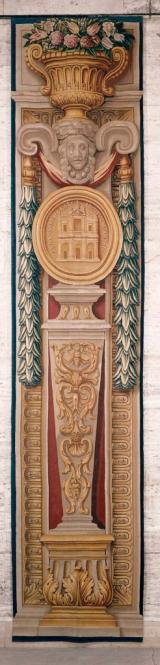
Four pillar tapestries (from the series THE LIFE OF POPE URBAN VIII)
Measurements
Each about 222 x 48 inches
Credit Line
Gift of Eugene L. Garbáty in memory of his parents, Josef and Rosa Garbáty and Charles Potter Kling Fund
Creation Date
1663-1679
Object Type
Object URL
http://www.mfa.org/collections/object/four-pillar-tapestries-from-the-series-the-life-of-pope-urban-viii-553213

Claim Resolution

Resolution
Agreement reached, museum retained work
Resolution Date
March, 2011
Details of Resolution
In March, 2011, the Museum of Fine Arts, Boston finalized a settlement with the heirs of Jakob and Rosa Oppenheimer, allowing the museum to retain four seventeenth-century tapestries, which were included in a forced sale in Berlin in 1935.

The four tapestries were part of a larger series that depicted the life and achievements of Pope Urban VIII. By 1928, eight tapestries from the series, including the four at the MFA, were owned by the art dealer Margraf in Berlin. Margraf was run by Jakob Oppenheimer and his wife Rosa, who were Jewish. In 1933, the Oppenheimers fled Germany to avoid Nazi persecution and relocated to France. During their absence they were forced out of their management roles at Margraf and were forbidden from performing any legal transactions for the company.

As a well-known Jewish business, Margraf was extinguished as quickly as possible by the Nazi regime. The gallery stock was sold off rapidly in a series of auctions held in Berlin in 1935. The Oppenheimers were unable to realize the proceeds from these sales. Recent research confirmed that the four MFA tapestries were sold to an unknown buyer at one of the 1935 auctions. The MFA contacted the Oppenheimer heirs in 2010 to inform them of their location at the MFA, and to begin settlement discussions.

The tapestries have been at the MFA since the 1950s, and were gifts from Eugene Garbáty, a German Jewish art collector. Garbáty purchased six of the eight tapestries from an unknown dealer shortly after they sold at auction in 1935. He was told that they had come out of a castle in Austria, and was unaware that they had belonged to Margraf or been in a forced sale. Garbáty, himself a victim of Nazi persecution, brought four of the tapestries with him when he fled Germany for the United States in 1939; he gave them to the MFA between 1950 and 1952.

46.1198

Creator
Bohemian workshop
Object Title
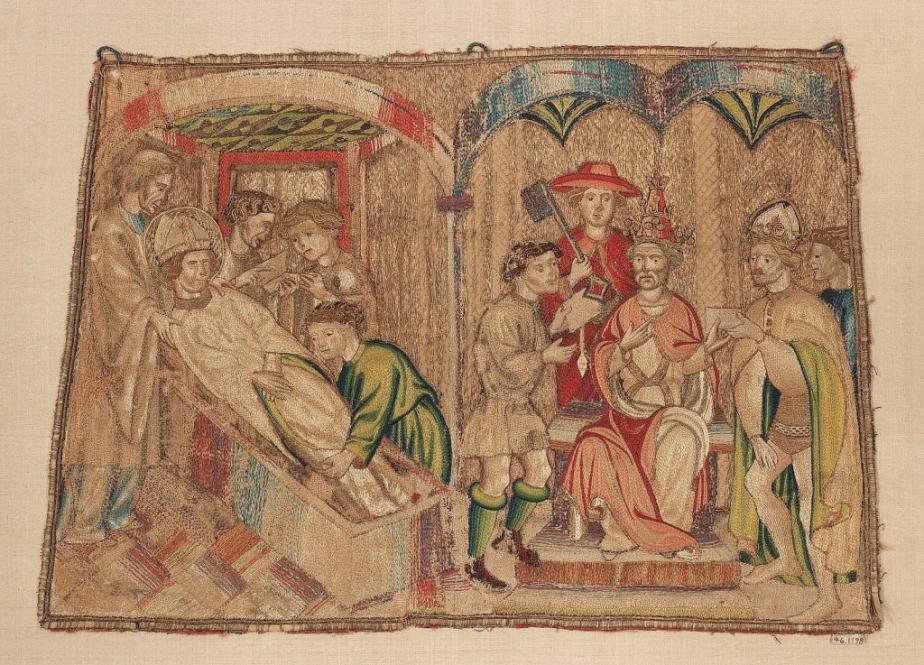
Entombment of Saint Vigilius
Measurements
35 x 49.3 cm (13 3/4 x 19 7/16 in.)
Credit Line
Otis Norcross Fund
Creation Date
About 1390-1391
Object Type
Object URL
http://www.mfa.org/collections/object/embroidered-panel-49020

Claim Resolution

Resolution
Work restituted to heirs or other representatives
Resolution Date
2010
Details of Resolution
In the fall of 2010, the MFA returned to the Museo Diocesano Tridentino (Diocesan Museum of Trent, Italy) an embroidered panel, the Entombment of Saint Vigilius, dating from around 1390–1391. The embroidery depicts the burial of Saint Vigilius (b. about 353–d. 405), the third bishop and patron saint of Trent, and the delivery of the news of his martyrdom to the pope and Emperor Theodosius.

The narrative cycle of the life of the saint was depicted on a number of embroidered panels, which were originally sewn onto the consecration vestments of George of Liechtenstein, appointed bishop prince of Trent in 1390. In the early 20th century, the five embroideries that remained from the original cycle were housed in the Museo Diocesano Tridentino. The museum’s original location in the Theological Seminary was subsequently closed, and the embroideries were placed in the cathedral sacristy. There, presumably between 1939 and 1944, all trace was lost of the panel showing the burial of Vigilius and the announcement of his death. The MFA purchased the embroidery in 1946 from an Italian art dealer in New York without knowledge of its subject matter or provenance. Prior to the acquisition, curatorial staff inquired about its history and were told only that its previous owner had inherited it along with a large collection of other antique objects. The Museum had no additional information about its provenance until 2008, when Dr. Evelin Wetter of the Abegg-Stiftung (Riggisberg, Switzerland) contacted the MFA, indicating that the panel was once part of the Saint Vigilius series from the Museo Diocesano Tridentino. Curatorial research by the MFA confirmed that the embroidery belonged to that series. In June 2008, the MFA contacted the Museo Diocesano to initiate discussions about its return, which concluded in April 2010 with the signing of an agreement by the MFA, the Archdiocese of Trent, and the Museo Diocesano.

2009.318

Object Title
Cylinder Vase
Measurements
10.5 x 10.2 cm (4 1/8 x 4 in.)
Creation Date
A.D. 740-775
Credit Line
Anonymous gift
Culture
Country of Origin
Object Type
Materials / Techniques
Object URL
http://www.mfa.org/collections/object/cylinder-vase-518462
Provenance Information
1970s, in a collection outside of Guatemala [see note 1]. By 1981, in a collection in New York [see note 2]. By 1987 until at least 1994, Carol Meyer, New York [see note 3]. May 10, 2008, anonymous sale, Skinner, Boston, lot 37, to a private collector; 2009, gift of this private collector to the MFA. (Accession Date: February 25, 2009)

NOTES: [1] Nicholas Hellmuth, who photographed Pre-Columbian objects in collections outside of Latin America, photographed the vase in the 1970s. [2] Justin Kerr photographed it in New York City in 1981 (no. K1463). [3] The vase was on loan to the Yale University Art Gallery during this time.


Exhibition Information
On loan to the Yale University Art Gallery from 1987 until 1994.
Publication Information
Justin and Barbara Kerr, Maya Vase Book (New York: Kerr Associates, 1989), vol. 1: 89.

Dorie Reents-Budet et al., Painting the Maya Universe: Royal Ceramics of the Classic Period (Durham, NC: Duke University Press, 1994), p. 168, fig. 5.4.

Dorie Reents-Budet et al., “Interacciones Politicas y el Sitio Ik’ (Motul de San José): Datos de la Cerámica,” pp. 1141-1161 in XX Simposio (2006) de Investigaciones Arqueológicas en Guatemala, 2006: Museo Nacional de Antropología e Etnología, ed. J. P. Laporte, B. Arroyo and H. Mejía (Guatemala: Ministerio de Cultura y Deportes, 2007).
Section of the AAMD Guidelines relied upon for the exception to 1970
Cumulative facts and circumstances
Explain why the object fits the exception set forth above
The MFA proceeded with the acquisition in light of the vase’s extensive exhibition and publication history and because it was outside of Guatemala by the 1970s.

2008.1057

Object Title
Medallion of Pergamum with Bust of Commodus, struck under P. Aelius Pius
Measurements
Diameter: 45 mm.; weight: 47.06 gm.; die axis: 1
Creation Date
A.D. 180—182
Credit Line
Gift of Cornelius C. Vermeule III
Culture
Country of Origin
Object Type
Materials / Techniques
Object URL
http://www.mfa.org/collections/object/medallion-of-pergamum-with-bust-of-commodus-struck-under-p-aelius-pius-446681
Provenance Information
November 20-21, 1981, anonymous sale (Auction 11), Frank Sternberg AG, Zürich, lot 268, sold to Cornelius C. Vermeule, III (b. 1925 – d. 2008), Cambridge, MA [see note 1]; 2008, gift of Vermeule to the MFA. (Accession Date: October 22, 2008)

NOTES: [1] Lent by Cornelius Vermeule to the MFA from 2004 until 2008 (loan no. L-G 115.2.2004).
Exhibition Information
Not known
Publication Information
Not known
Section of the AAMD Guidelines relied upon for the exception to 1970
Cumulative facts and circumstances
Explain why the object fits the exception set forth above
The date and circumstances of the coin’s discovery are not known. The coin’s appearance in a 1981 auction in Switzerland ensures that it has been outside Turkey, its probable country of modern discovery, since before the passage of Law no. 2863 on the Protection of Cultural and National Assets (1983).

2008.1056

Object Title
Coin of Anchialus with bust of Gordian III
Measurements
Diameter: 38 mm.; weight: 37.88 gm.; die axis: 12
Creation Date
A.D. 238–244
Credit Line
Gift of Cornelius C. Vermeule III
Culture
Country of Origin
Object Type
Materials / Techniques
Object URL
http://www.mfa.org/collections/object/coin-of-anchialus-with-bust-of-gordian-iii-446679
Provenance Information
November 20-21, 1981, anonymous sale (Auction 11), Frank Sternberg AG, Zürich, lot 227, sold to Cornelius C. Vermeule, III (b. 1925 – d. 2008), Cambridge, MA [see note 1]; 2008, gift of Vermeule to the MFA. (Accession Date: October 22, 2008)

NOTES: [1] Lent by Cornelius Vermeule to the MFA from 2004 until 2008 (loan no. L-G 115.1.2004).
Exhibition Information
None known
Publication Information
None known
Section of the AAMD Guidelines relied upon for the exception to 1970
Cumulative facts and circumstances
Explain why the object fits the exception set forth above
This coin appeared in an auction in Switzerland nearly thirty years ago, though the date and circumstances of the its discovery are not known. While the location of Anchialus, the mint at which this coin was struck, falls within the borders of present-day Bulgaria, the city was one of the principal urban centers of the Roman province of Thrace, and the circulation of its coinage would have extended into present-day Greece and Turkey; thus its findspot cannot be placed within the boundaries of a single modern country.

1973.196

Creator
Oskar Kokoschka, Austrian, 1886–1980
Object Title
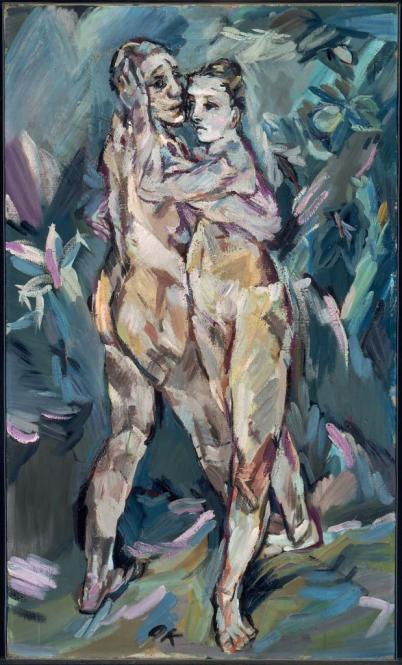
Two Nudes (Lovers)
Measurements
163.2 x 97.5 cm (64 1/4 x 38 3/8 in.)
Credit Line
Bequest of Sarah Reed Platt
Creation Date
1913
Object Type
Object URL
http://www.mfa.org/collections/object/two-nudes-lovers-34173

Claim Resolution

Resolution
Court rejected claim
Resolution Date
May 29, 2009
Details of Resolution
In March 2007, the Museum of Fine Arts received a restitution claim for Oskar Kokoschka’s Two Nudes (Lovers) (accession no. 1973.196). Claudia Seger-Thomschitz, represented as the sole and unrelated heir of the last surviving son of Oskar Reichel, the painting’s former owner, asserted that Reichel was forced to sell Two Nudes (Lovers) under duress in Nazi-occupied Austria in 1939; later, her counsel asserted that the painting had been confiscated from Reichel by the Nazis. Upon receipt of the claim, the MFA conducted a comprehensive investigation of the painting’s provenance and concluded that it has legal title to the work. The MFA shared with the claimant’s counsel the results of its research. When the claim was not withdrawn, the Museum filed suit in January 2008 to confirm its ownership of the painting. In May 2009, U.S. District Judge Rya Zobel ruled that the MFA is entitled to retain ownership of Two Nudes (Lovers); the First Circuit Court of Appeals upheld this decision in October 2010. A brief summary of the research is presented here.

Oskar Reichel (b. 1869 – d. 1943) of Vienna, who was Jewish, was a prominent collector of Austrian Expressionist art. He patronized contemporary artists, including Egon Schiele, Max Oppenheimer, and Oskar Kokoschka. Reichel actively bought and sold their work, playing an important role on the Viennese art market. He probably bought Two Nudes (Lovers) directly from Kokoschka around 1914 or 1915, shortly after it was painted.

By 1924, Reichel had developed a business relationship with Otto Kallir (b. 1894 - d. 1978), a Jewish art dealer who opened the Neue Galerie in Vienna in 1923. Reichel consigned Two Nudes (Lovers), along with other paintings by Kokoschka, for sale through Kallir in the 1920s and 1930s. In 1938, Kallir fled Vienna and turned the Neue Galerie over to his non-Jewish secretary. He opened a new gallery, the Galerie St. Etienne, in Paris. In February 1939, Reichel transferred ownership of five Kokoschka paintings—including Two Nudes (Lovers)—to Kallir, who exhibited them in his Paris gallery that spring. Later that year, Kallir emigrated to New York and opened a branch of the Galerie St. Etienne there. He exhibited Two Nudes (Lovers) frequently between 1940 and 1945, both in his New York gallery and in traveling exhibitions throughout the United States. From New York, Kallir sent money for the five Kokoschka paintings to Oskar Reichel’s two sons, Raimund and Hans, with whom he was in communication; they were living in South America and the United States, respectively.

Although Raimund and Hans had been able to leave Austria, Oskar Reichel and his wife Malvine remained in Vienna. Their home furnishings company was forcibly closed after the anti-Jewish riots of Kristallnacht in 1938, and in 1941 they were forced to sell their shares in a family-owned building, with the proceeds going into blocked accounts. Their oldest son, Max, who was mentally ill, was deported and killed. In 1943, Oskar passed away from natural causes and Malvine Reichel was sent to the Theresienstadt concentration camp. She survived and joined her son Hans in the United States after the war. Malvine Reichel made successful restitution claims for certain assets lost in Austria, including the property sold in 1941. She relinquished her claim to other assets, including the family home, which she had sold to acquaintances in 1938. Raimund Reichel applied for and received compensation from the Austrian authorities for damages due to Nazi persecution. In his application, he referred specifically to paintings by Anton Romako that his father had sold under duress. However, no claim was ever made for any of the five Kokoschka paintings, nor was any indication made that members of the Reichel family considered the 1939 transaction to be invalid.

In 1945, Kallir sold Two Nudes (Lovers) on the New York art market. Around 1948 it was acquired by Sarah Reed Blodgett (later Platt), who bequeathed it to the MFA in 1973. Since that time, the painting has been exhibited and published extensively. It is currently on view in the Rabb Gallery at the MFA.

1970.77

Creator
Unidentified artist, Polish
Object Title
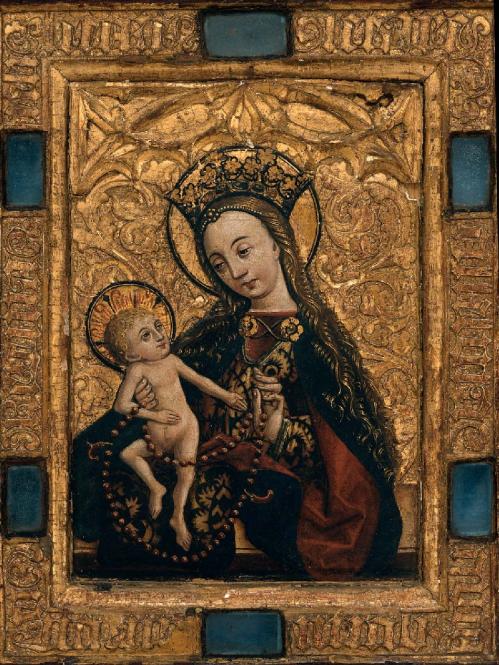
Virgin and Child
Measurements
43.8 x 34.3 cm (17 1/4 x 13 1/2 in.)
Credit Line
M. Theresa B. Hopkins Fund
Creation Date
15th century
Object Type
Object URL
http://www.mfa.org/collections/object/virgin-and-child-34073

Claim Resolution

Resolution
Work restituted to heirs or other representatives
Resolution Date
November 18, 2004
Details of Resolution
On November 18, 2004, the MFA deaccessioned the panel painting Virgin and Child for restitution to its rightful owner, Mrs. Anna Konopka Unrug of Poland. This was in response to the restitution claim for the painting received from the Ministry of Foreign Affairs of the Republic of Poland on behalf of Mrs. Unrug.

The painting once formed the central panel of a triptych that belonged to Mrs. Unrug’s grandfather, Tadeusz Konopka (b. 1844 – d. 1903), and was passed by descent to his son, Józef (b. 1884 –d . 1940) of Jaroslaw and Warsaw. Józef was killed in 1940 after being taken hostage by the Red Army. The painting remained in his Warsaw apartment, where his wife Helena (b. 1899) and daughter Anna (b. 1921) lived, and was plundered during the Warsaw Uprising of 1944. It is not known when the triptych was separated; neither of the side panels has been located.

The MFA purchased the painting in 1970 from a dealer in Frankfurt, Germany, without knowledge of its wartime or immediate postwar provenance. At that time it was attributed to the Master of the Saint Barbara Altar, a Silesian painter active in the fifteenth century. Research by curatorial staff revealed that it had been in Tadeusz Konopka’s possession and remained in Poland during World War II. This information was made available on the MFA Web site, which enabled the claimant, through the Polish Ambassador, to locate the painting.
Subscribe to Museum of Fine Arts Boston