
Object Title
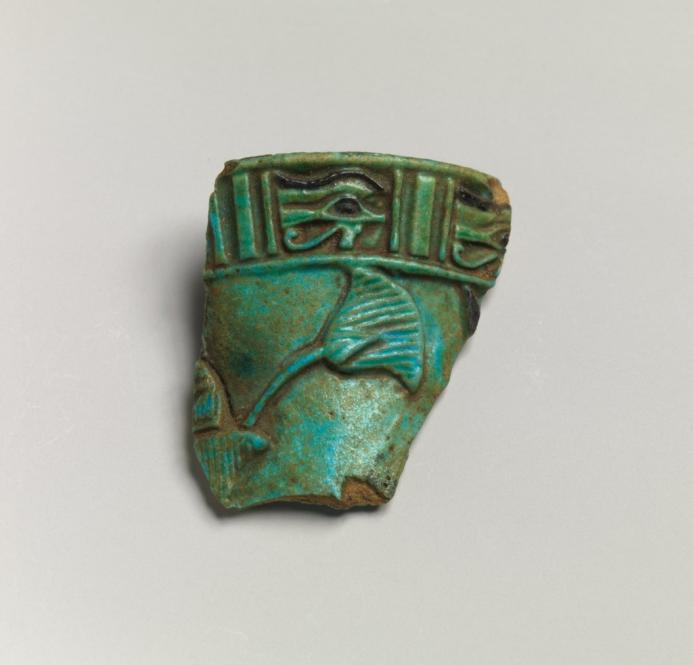
Relief Chalice Fragment
Measurements
1 9/16 in. x 1 3/8 in. (4 cm x 3.5 cm)
Creation Date
ca. 1070-712 B.C.
Credit Line
Purchase, Ernest L. Folk Bequest and Funds from Various Donors, 2010
Museum Name
Culture
Country of Origin
Object Type
Materials / Techniques
Object URL
http://www.metmuseum.org/Works_of_Art/collection_database/egyptian_art/relief_chalice_fragment/objectview.aspx?OID=100047066&collID=10&dd1=10
Provenance Information
Most probably in the MacGregor Collection, which was sold at auction by Sotheby’s London, June 27, 1922, lot 293 (this work was likely one of the twenty-two objects auctioned in that lot). Collection of Michel (or Michael) Abemayor, New York, until 1972 or 1973. Purchased in 1972 or 1973 by Peter Sharrer, New York and New Jersey. Consigned by Peter Sharrer to auction at Sotheby’s New York, December 10, 2009, lot 62, where it was purchased by The Metropolitan Museum of Art.
Exhibition Information
The work was exhibited in connection with the Sotheby’s auctions.
Publication Information
The work was published in the Sotheby’s auction catalogues.
Section of the AAMD Guidelines relied upon for the exception to 1970
Informed judgement that works were outside of the country of modern discovery before 1970
Explain why the object fits the exception set forth above
The work has provenance established to 1972 or 1973. The Metropolitan Museum of Art already owns one additional fragment from this chalice, which was sold at the Sotheby’s auction in 1922. It is likely that this work was also sold at the 1922 auction, but The Metropolitan Museum of Art has been unable to substantiate this because the 1922 sale was a sale of a group lot, and the auction catalogue contains no photographs, no illustrations and only scant description of each of the twenty-two objects in the lot. The Metropolitan Museum of Art acquired this work in order to join it with the matching fragment already in its collection. Every chalice is unique and this type of chalice is important in establishing a visual repertory of the Third Intermediate Period.