
Creator
Barberini Manufactory, Rome
Object Title
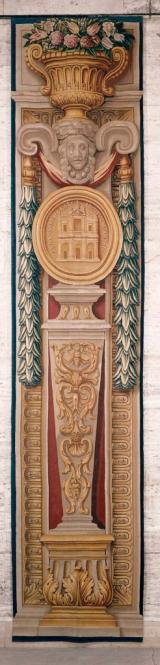
Four pillar tapestries (from the series THE LIFE OF POPE URBAN VIII)
Measurements
Each about 222 x 48 inches
Credit Line
Gift of Eugene L. Garbáty in memory of his parents, Josef and Rosa Garbáty and Charles Potter Kling Fund
Creation Date
1663-1679
Museum Name
Object Type
Object URL
http://www.mfa.org/collections/object/four-pillar-tapestries-from-the-series-the-life-of-pope-urban-viii-553213
Claim Resolution
Resolution
Agreement reached, museum retained work
Resolution Date
March, 2011
Details of Resolution
In March, 2011, the Museum of Fine Arts, Boston finalized a settlement with the heirs of Jakob and Rosa Oppenheimer, allowing the museum to retain four seventeenth-century tapestries, which were included in a forced sale in Berlin in 1935.
The four tapestries were part of a larger series that depicted the life and achievements of Pope Urban VIII. By 1928, eight tapestries from the series, including the four at the MFA, were owned by the art dealer Margraf in Berlin. Margraf was run by Jakob Oppenheimer and his wife Rosa, who were Jewish. In 1933, the Oppenheimers fled Germany to avoid Nazi persecution and relocated to France. During their absence they were forced out of their management roles at Margraf and were forbidden from performing any legal transactions for the company.
As a well-known Jewish business, Margraf was extinguished as quickly as possible by the Nazi regime. The gallery stock was sold off rapidly in a series of auctions held in Berlin in 1935. The Oppenheimers were unable to realize the proceeds from these sales. Recent research confirmed that the four MFA tapestries were sold to an unknown buyer at one of the 1935 auctions. The MFA contacted the Oppenheimer heirs in 2010 to inform them of their location at the MFA, and to begin settlement discussions.
The tapestries have been at the MFA since the 1950s, and were gifts from Eugene Garbáty, a German Jewish art collector. Garbáty purchased six of the eight tapestries from an unknown dealer shortly after they sold at auction in 1935. He was told that they had come out of a castle in Austria, and was unaware that they had belonged to Margraf or been in a forced sale. Garbáty, himself a victim of Nazi persecution, brought four of the tapestries with him when he fled Germany for the United States in 1939; he gave them to the MFA between 1950 and 1952.